Concrete Drainage, Slope & Water Management Guide
Proper drainage and pitch are essential for long-term concrete slab performance in Maryland. Water pooling on or alongside driveways, patios, walkways, garage entrances, and foundation slabs can lead to soil erosion, subgrade saturation, frost heaving, surface icing, joint breakdown, and slab settlement. Managing surface runoff through appropriate slope design, downspout management, swales, and integrated trench or channel drains prevents water from compromising hardscape structures. This technical guide from Gaithersburg Concrete explains outdoor pitch standards, common runoff problems, drainage correction options, and how site grading protects flatwork in Gaithersburg and Montgomery County.
Request a Free Estimate
Tell us about your concrete project in Gaithersburg or nearby.
Why Drainage Matters for Concrete
Concrete performs best when surface water has a predictable, uninterrupted flow path away from building foundations and pedestrian zones. Poor drainage leads to standing water, subgrade soil saturation, base erosion, winter ice sheets, and accelerated freeze-thaw deterioration. Controlling water movement before, during, and after slab placement is a primary requirement for long-term flatwork durability.
Primary Risks of Inadequate Drainage
- Subgrade Soil Softening & Settlement: Standing water saturates underlying clay soils, reducing load-bearing capacity and causing slab dipping.
- Winter Ice Hazards: Low spots collect water that freezes into hidden black ice sheets across driveways and walkways.
- Foundation Water Exposure: Patios pitched toward the home direct stormwater against exterior foundation walls, increasing basement moisture risks.
- Base Erosion: Concentrated runoff from downspouts or sloped yards washes away crushed aggregate base along slab edges.
How Water Moves Around Concrete
Managing stormwater across hardscape surfaces relies on physics, geometry, and proper site grading:
Standard Slope Requirements for Concrete
Exterior flatwork must be sloped away from buildings to prevent water accumulation. Industry standard pitch for patios, walkways, and driveways is a minimum of 1/8 inch to 1/4 inch of drop per linear foot (approximately a 1% to 2% slope grade). Patios connected to house walls require a strict minimum 1/4-inch per foot drop away from the structure.
Cross-Slope vs. Longitudinal Slope
Driveways on hills or sloped lots often incorporate cross-slope (crowning or side-pitching) to shed water off the pavement edges quickly before velocity causes erosion along the lower driveway entrance.
The Impossibility of 'Perfectly Flat' Outdoor Slabs
Outdoor concrete should never be poured perfectly level. True level leads to standing birdbaths whenever micro-variations or rainfall occur. A properly graded slab incorporates intentional slope for active drainage.
Common Concrete Drainage Problems
Properties in Gaithersburg frequently face distinct hardscape drainage challenges due to clay-heavy soils and sloped terrain:
1. Driveway Runoff Towards Garage Doors
Driveways sloped downhill toward a home direct stormwater straight into garage thresholds or basement entries. Without channel drains, heavy rain breaches door seals.
2. Patio Ponding & Reverse Pitch
Settlement over time near house foundations causes old patios to reverse pitch, directing rainwater directly toward foundation walls and basement window wells.
3. Roof Downspout Discharge On Concrete
Roof downspouts discharging directly onto concrete driveways or patios cause localized surface erosion, severe winter icing, and concentrated subgrade saturation.
Slope, Trench Drains, Leveling & Replacement
Correcting concrete water management depends on site topography, existing slab condition, and water volume:
Concrete Trench Drains & Channel Drains
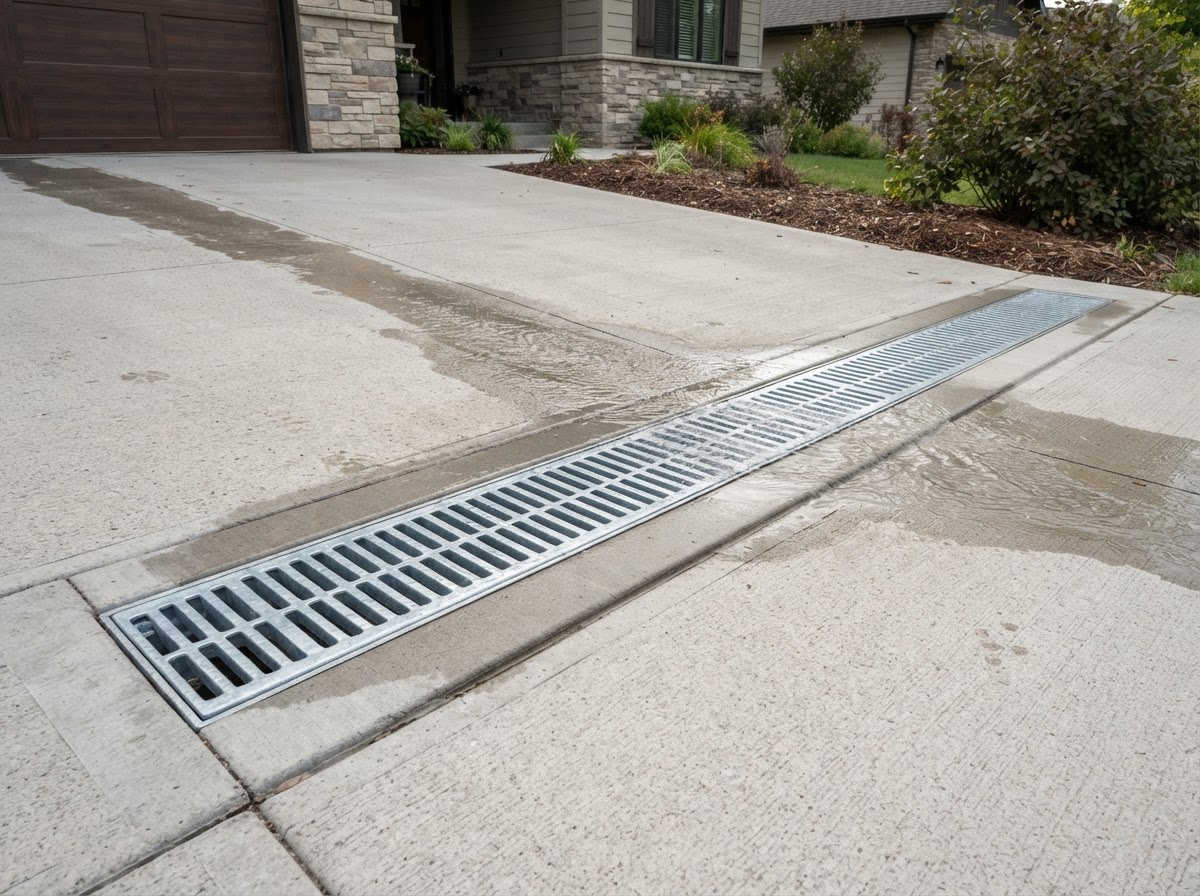
Installing a polymer or concrete trench drain across a driveway apron or patio threshold intercepts surface water sheets before they reach garage doors or structures, channeling runoff to approved outlets.
Concrete Leveling / Mudjacking for Pitch Correction
When an intact slab has settled toward a foundation, slab lifting and mudjacking can pump material underneath to raise the settled edge and restore proper outward slope.
Full Replacement & Subgrade Grading
Severely broken or improperly poured slabs with reverse slope often require full removal, subgrade excavation, new crushed stone base, and re-pouring to correct grade geometry.
Explore our concrete trench drain installation page for details on channel drainage options.
Water, Freeze-Thaw & Settlement in Maryland
Montgomery County soils feature high clay content, which expands when wet and shrinks during dry spells. Poor drainage exacerbates soil movement:
Soil Saturation & Frost Heaving
Saturated subgrade soils under driveways expand significantly when winter freeze cycles occur. Uncontrolled water trapped beneath concrete heaves slabs upward, creating uneven joints and cracking.
Erosion & Void Formation
Uncontrolled runoff flowing along slab edges washes away fine subbase aggregates, creating underground voids that lead to sudden corner cracking under car weight.
Concrete Drainage Evaluation Checklist
Homeowner Drainage Assessment Checklist
- Observe Heavy Rainfall: Walk your driveway and patio during heavy rain to map water flow paths and pooling areas.
- Check Slope Direction: Verify that all patios, walkways, and driveway sections slope away from building foundation walls.
- Inspect Downspouts: Ensure roof downspouts discharge at least 3 to 5 feet away from concrete slab edges or connect to underground pipe drains.
- Examine Expansion Joints: Check if open, unsealed joints allow water to pour under the slab.
- Evaluate Garage Thresholds: Look for water staining or rot along garage door frames.
Direct Answer: Should Concrete Be Level?
No. Outdoor concrete should never be level. It must always incorporate a minimum 1% to 2% slope (1/8" to 1/4" per foot) to ensure water drains away actively.
Discuss Your Concrete Project
Have questions about scope, timing, or whether repair or replacement is the right call? We are happy to review your project and provide a clear, honest estimate.
Concrete Drainage FAQs
Why does water pool on my concrete driveway or patio?
Water pools when the concrete surface lacks adequate drainage slope (less than 1/8 inch drop per foot), when localized settlement creates low birdbaths, or when surrounding soil landscape beds are higher than the concrete edge.
How much slope should a concrete patio have?
A concrete patio should have a minimum slope of 1/4 inch of fall for every 1 linear foot away from the house (a 2% slope) to guarantee water drains away from foundation walls.
Can a trench drain be added to an existing concrete driveway?
Yes. Contractors sawcut and remove a channel section across the driveway, excavate to proper depth, set a pre-formed trench drain channel with heavy-duty grates, connect outlet piping, and pour surrounding concrete flush with the pavement.
Can concrete leveling fix water pooling problems?
If the slab is intact and water pooling is caused by one settled section dipping toward a building, concrete leveling can raise the low slab edge to restore positive outward pitch.
Can standing water damage concrete over time?
Yes. Standing water saturates concrete pores, accelerating freeze-thaw scaling, weakening subgrade soils, causing settlement, and creating severe winter ice hazards.
How do downspouts affect concrete driveways and walkways?
Downspouts discharging concentrated roof water onto concrete erode slab edges, wash out supporting base rock, create localized ice patches in winter, and cause surface staining.
What is a swale and how does it protect concrete?
A swale is a wide, shallow sloped landscape channel lined with grass or stone that directs surface water around driveways, patios, and yards, keeping heavy runoff away from concrete hardscape.
Facing Water Pooling or Drainage Problems on Your Concrete?
Gaithersburg Concrete evaluates slope, subgrade condition, downspouts, and surface runoff to install effective concrete trench drains, regraded slabs, and pitch-corrected flatwork in Gaithersburg and Montgomery County. Call (240) 690-6035 or request a free estimate.
Keep Learning About Concrete in Gaithersburg
Concrete Thickness, Base & Reinforcement Guide
How intended use, loads, site conditions, base preparation and reinforcement affect concrete slab planning for driveways, patios and pads.
Read the guideConcrete Leveling vs. Replacement
Whether sunken concrete can be leveled or needs replacement — slab condition, cracking, settlement and base failure in Gaithersburg.
Read the guideMaryland Freeze-Thaw, Deicing Salt & Concrete Damage Guide
How freeze-thaw cycles, moisture, and deicing salts cause scaling and cracking in Maryland, plus winter protection strategies.
Read the guideRelated Concrete Services Near Gaithersburg
Concrete Trench Drains & Drainage Channels
Concrete trench drains and drainage channels for driveways, patios, and flatwork that intercept surface water and direct it toward an appropriate discharge point.
Learn moreConcrete Driveway Installation & Replacement
Durable residential and light commercial concrete driveways built to withstand vehicular weight and Maryland freeze-thaw cycles.
Learn moreConcrete Patio Installation & Replacement
Custom concrete backyard patios engineered for outdoor living, cookouts, and year-round family entertainment.
Learn moreSunken Concrete Slab Leveling & Trip Hazard Repair
Leveling of sunken, uneven concrete slabs and trip hazard repair for sidewalks, patios, and driveways.
Learn moreConcrete Curb & Gutter Installation and Repair
Concrete curb and gutter installation, replacement, and repair for private and commercial sites.
Learn moreFacing Water Pooling or Drainage Problems on Your Concrete?
Gaithersburg Concrete evaluates slope, subgrade condition, downspouts, and surface runoff to install effective concrete trench drains, regraded slabs, and pitch-corrected flatwork in Gaithersburg and Montgomery County. Call (240) 690-6035 or request a free estimate.
- Project-specific estimates — no obligation
- Residential and commercial concrete work
- Serving Gaithersburg and surrounding Montgomery County
Request a Free Estimate
Tell us about your concrete project in Gaithersburg or nearby.