Concrete Driveway Drainage Repair in Gaithersburg, MD
Standing water on a concrete driveway can result from low spots, settlement, inadequate surface drainage, adjacent grade, or runoff patterns. The right correction may involve leveling, replacing affected concrete, adjusting slab geometry, or integrating a trench or channel drain where appropriate — but no single solution fits every driveway. In Gaithersburg, rainfall, snowmelt, and freeze-thaw cycles make driveway drainage a recurring concern, because water that pools on or runs beneath a slab erodes the base, contributes to settlement, and accelerates surface damage. Gaithersburg Concrete evaluates where the water is coming from, where it is collecting, and what the slab and grade will actually support before recommending a drainage-focused concrete repair. We do not assume a trench drain fixes every problem, and we do not claim to perform unrelated drainage trades unless verified.
Request a Free Estimate
Tell us about your concrete project in Gaithersburg or nearby.
Concrete Driveway Drainage Repair in Gaithersburg
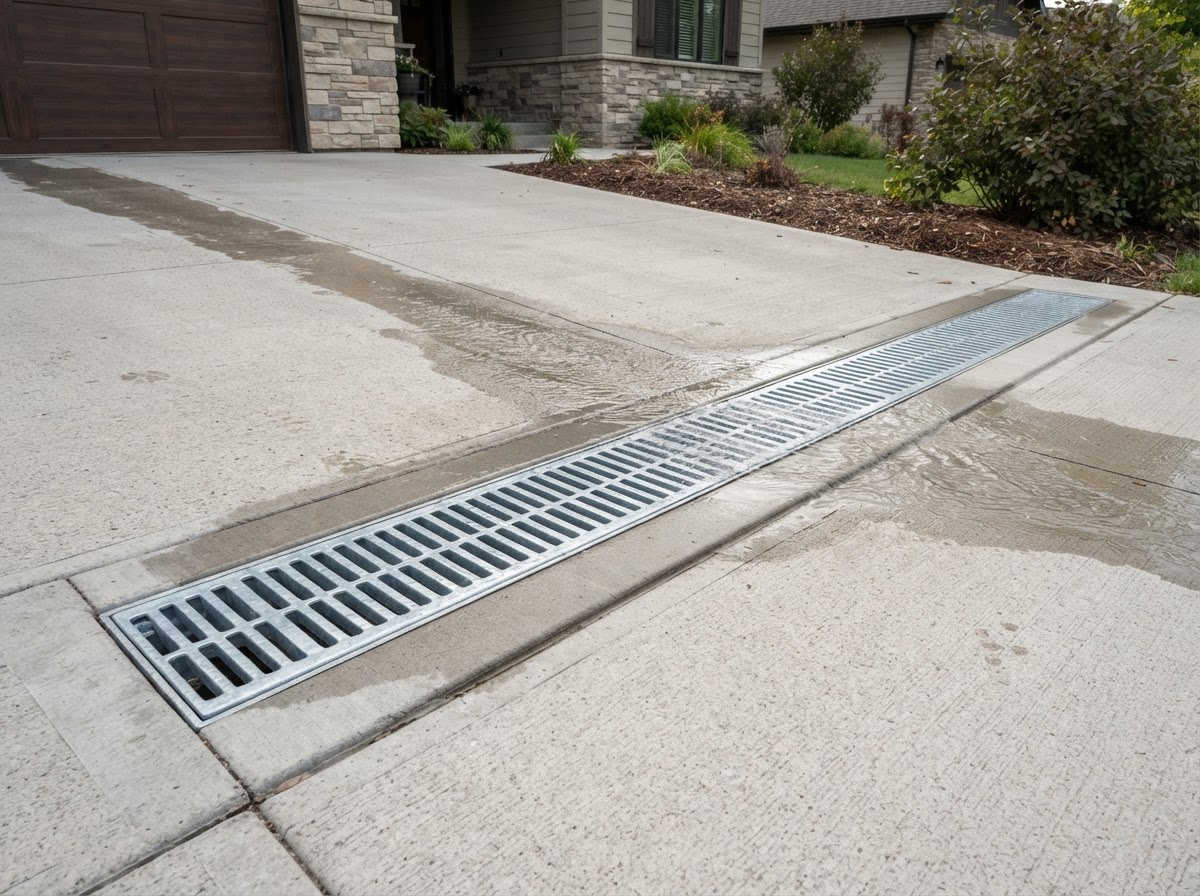
Driveway drainage repair addresses the water problems that show up on a concrete driveway — pooling, low spots, runoff crossing the slab, water collecting at the garage door, or edge erosion. The goal is to correct how water moves across and away from the driveway so it stops collecting where it causes damage, rather than treating the symptom and leaving the cause in place.
The right correction depends on what is actually causing the water to collect. A localized low spot may be a leveling candidate; a slab set at the wrong geometry may need partial replacement; runoff crossing the driveway may need a drainage evaluation; water at the garage may point to a slope or channel-drain solution. We do not imply that one approach fits every driveway, because the cause determines the fix.
Drainage issues can affect both usability and concrete durability. A driveway that ponds water is harder to use in wet weather, contributes to icing in winter, and lets moisture undermine the base — which leads to settlement and cracking over time. Correcting drainage is often part of a lasting concrete repair, not separate from it.
Common Driveway Drainage Problems
Drivewater problems fall into a few patterns, and each points toward a different direction. Identifying where the water comes from and where it collects is the first step, because the cause determines whether the fix is leveling, replacement, a drain, or grade coordination.
Drainage Problems We Evaluate
- Water pooling on the slab surface after rain
- Low spots that collect water and debris
- Garage-door pooling where water runs toward the entry
- Runoff crossing the driveway from adjacent grade or downspouts
- Edge erosion where water runs off the slab edge
- Settled slabs that have dropped below the drainage plane
- Snowmelt accumulation and repeated icing in low areas
- Water moving toward the house or foundation
- Failed or clogged drainage channels
Each problem has a different likely direction. A localized low slab may be a leveling candidate; a slab at the wrong geometry may need partial replacement; runoff crossing the driveway may need a drainage evaluation; water near the garage may point to a slope or channel-drain solution; and edge erosion may indicate a drainage or base problem. We do not diagnose remotely — the actual site conditions determine the recommendation.
| Problem | Possible Direction |
|---|---|
| Localized low slab | Leveling evaluation |
| Incorrect slab geometry | Partial replacement |
| Runoff crossing driveway | Drainage evaluation |
| Water near garage | Slope / channel-drain evaluation |
| Edge erosion | Drainage / base evaluation |
How Driveway Drainage Problems Are Evaluated
A drainage-focused driveway evaluation starts with understanding where the water comes from and where it needs to go, then determines what concrete work — if any — is required to get it there. The process is diagnostic before it is corrective.
- 1Identify the water source — rainfall, snowmelt, runoff, downspouts, or adjacent grade.
- 2Inspect driveway elevations — check the slope and where water is meant to shed.
- 3Identify low spots — locate where water collects on the slab.
- 4Assess settlement — determine whether a slab has dropped below the drainage plane.
- 5Inspect the garage transition — check whether water runs toward the entry.
- 6Inspect adjacent grade — review how the surrounding ground and landscaping affect flow.
- 7Evaluate downspout contribution — check whether roof runoff is directed onto the driveway.
- 8Identify a feasible discharge path — confirm where water can be sent without creating a new problem.
- 9Determine the concrete work required — leveling, localized replacement, reconstruction, or a drain.
- 10Select the repair method — match the solution to the actual cause and site conditions.
Potential solutions may include leveling a settled slab, localized replacement of a low or damaged section, driveway reconstruction to correct geometry, a trench or channel drain to intercept surface water, edge or grade coordination, or joint repair. We do not claim Gaithersburg Concrete performs unrelated drainage trades unless verified — where a project needs work outside concrete, we are straightforward about that scope.
Leveling, Replacement, or Trench Drain?
The right drainage correction depends on what is causing the water to collect. Each option addresses a different problem, and a trench drain is not automatically the correct solution for every water issue.
When Each Approach May Help
- Leveling — may help when a slab has settled but the geometry can be restored and the slab remains suitable for lifting.
- Partial replacement — may help when a low area needs a new elevation or the affected section is damaged.
- Full replacement — may be considered when the driveway geometry is broadly unsuitable or the concrete has widespread failure.
- Trench or channel drain — may help intercept surface water where a suitable outlet exists.
A trench drain is not a universal answer. It is useful where surface water crosses the driveway and a feasible discharge path exists, but it does not lift a settled slab, correct a slab set at the wrong slope, or fix a failed base. Where the problem is settlement, leveling or replacement is usually the relevant direction; where the problem is runoff crossing the slab, a drain may be part of the solution. We recommend the approach that fits the actual cause.
Related services: concrete leveling and trench drains and drainage channels.
Maryland Rain, Freeze-Thaw & Driveway Water
Maryland's rainfall and snowmelt load make driveway drainage a recurring concern rather than a one-time fix. Rain that pools on a low spot, snowmelt that collects in a settled area, and freeze-thaw cycles that work moisture into the slab and base all contribute to the settlement, base erosion, and surface damage that turn a drainage issue into a concrete problem.
Repeated icing is a particular concern. A low area that holds water in warm weather holds ice in cold weather, creating a slip hazard and stressing the concrete as freeze-thaw cycles work the trapped moisture. Deicing salts applied to those wet, icy spots accelerate surface scaling. Correcting the drainage — not just treating the ice — is what stops the cycle.
Drainage issues affect both usability and concrete durability. A driveway that sheds water cleanly is easier to use, resists the scaling that freeze-thaw and deicers cause, and protects the base from the erosion that leads to settlement. Where drainage is the underlying cause of driveway damage, addressing it is part of a lasting repair — not separate from it.
Related resources: drainage and water management guide and leveling vs. replacement guide.
Seeing standing water or repeated driveway icing? Request a drainage-focused concrete evaluation to find the actual cause.
Discuss Your Concrete Project
Have questions about scope, timing, or whether repair or replacement is the right call? We are happy to review your project and provide a clear, honest estimate.
Concrete Driveway Drainage Repair FAQs & Estimates
Why does water pool on my concrete driveway?
Water pools where the slab has a low spot, has settled below the drainage plane, was set at a geometry that does not shed water, or where runoff from adjacent grade or downspouts collects on the surface. The cause determines the fix — leveling, localized replacement, regrading, or a drain. We evaluate where the water comes from and where it collects before recommending a direction.
Can a sunken driveway cause drainage problems?
Yes. A settled slab that has dropped below the surrounding drainage plane creates a low spot that collects water, and that pooled water can erode the base and worsen the settlement over time. Where the slab is intact and suitable for lifting, concrete leveling may restore the drainage plane; where it is cracked or failed, replacement may be needed. We assess whether the slab is a leveling or replacement candidate.
Can concrete leveling fix driveway drainage?
Sometimes. Where a settled slab is intact and suitable for lifting, leveling can raise it back toward the drainage plane and correct the low spot that collects water. Leveling does not fix a slab set at the wrong geometry, a failed base, or runoff from outside the driveway — those need a different solution. We evaluate whether leveling will actually correct the drainage before recommending it.
When is a trench drain useful?
A trench or channel drain is useful where surface water crosses the driveway and a feasible discharge path exists to send it away without creating a new problem. It is not a universal solution — it does not lift a settled slab or correct a slab set at the wrong slope. Where the problem is runoff crossing the slab, a drain may be part of the solution; where the problem is settlement, leveling or replacement is usually the relevant direction.
Can driveway slope be corrected?
Yes, where the slab condition and site allow it. Correcting the slope may involve leveling a settled section, partial replacement of a low area, or full reconstruction where the geometry is broadly unsuitable. The approach depends on what is causing the wrong slope and what the slab will support. We evaluate the actual conditions before recommending how to correct it.
Can standing water damage concrete?
Yes. Water that pools on or runs beneath a driveway erodes the base, contributes to settlement, and — combined with freeze-thaw cycles — accelerates surface scaling and cracking. A low spot that holds water in warm weather holds ice in cold weather, creating a slip hazard and stressing the concrete. Correcting the drainage protects both the usability and the durability of the slab.
What affects driveway drainage repair cost?
Cost depends on the cause and extent of the water problem, the length of the repair, whether leveling is feasible, whether concrete replacement is needed, whether a trench or channel drain is part of the scope, drainage and grade work, site access, and the complexity of redirecting the water. Because every driveway and drainage situation differs, we provide project-specific estimates rather than fixed rates.
Request a Concrete Driveway Drainage Evaluation
Standing water, low spots, or repeated icing on your driveway? Gaithersburg Concrete will find the actual cause and recommend the right drainage-focused concrete repair. Call (240) 690-6035 or request a free estimate.
Related Concrete Services Near Gaithersburg
Concrete Driveway Installation & Replacement
Durable residential and light commercial concrete driveways built to withstand vehicular weight and Maryland freeze-thaw cycles.
Learn moreConcrete Trench Drains & Drainage Channels
Concrete trench drains and drainage channels for driveways, patios, and flatwork that intercept surface water and direct it toward an appropriate discharge point.
Learn moreConcrete Leveling, Lifting & Mudjacking
Cost-effective lifting of sunken, uneven concrete slabs to eliminate trip hazards and restore positive drainage.
Learn moreConcrete Driveway Repair
Concrete driveway repair for localized cracks, broken edges, spalling, failed joints and single settled panels on otherwise sound driveways.
Learn moreRequest a Concrete Driveway Drainage Evaluation
Standing water, low spots, or repeated icing on your driveway? Gaithersburg Concrete will find the actual cause and recommend the right drainage-focused concrete repair. Call (240) 690-6035 or request a free estimate.
- Project-specific estimates — no obligation
- Residential and commercial concrete work
- Serving Gaithersburg and surrounding Montgomery County
Request a Free Estimate
Tell us about your concrete project in Gaithersburg or nearby.