Concrete Driveway Resurfacing in Gaithersburg, MD
Concrete driveway resurfacing is a surface-renewal process used on suitable existing driveways when the slab remains stable enough to preserve but the surface is worn, discolored, scaled, or otherwise deteriorated. It is not appropriate for every cracked or settled driveway, so the underlying slab condition should be evaluated first. In Gaithersburg, freeze-thaw cycles, deicing salts, and years of vehicle traffic take a predictable toll on driveway surfaces, and resurfacing can renew the appearance of a sound slab without the cost and disruption of full replacement — but only when the concrete beneath is actually suitable for an overlay. Gaithersburg Concrete evaluates the slab, cracks, drainage, and movement before recommending resurfacing, because an overlay applied over an unstable or actively moving slab will not hold.
Request a Free Estimate
Tell us about your concrete project in Gaithersburg or nearby.
Concrete Driveway Resurfacing in Gaithersburg
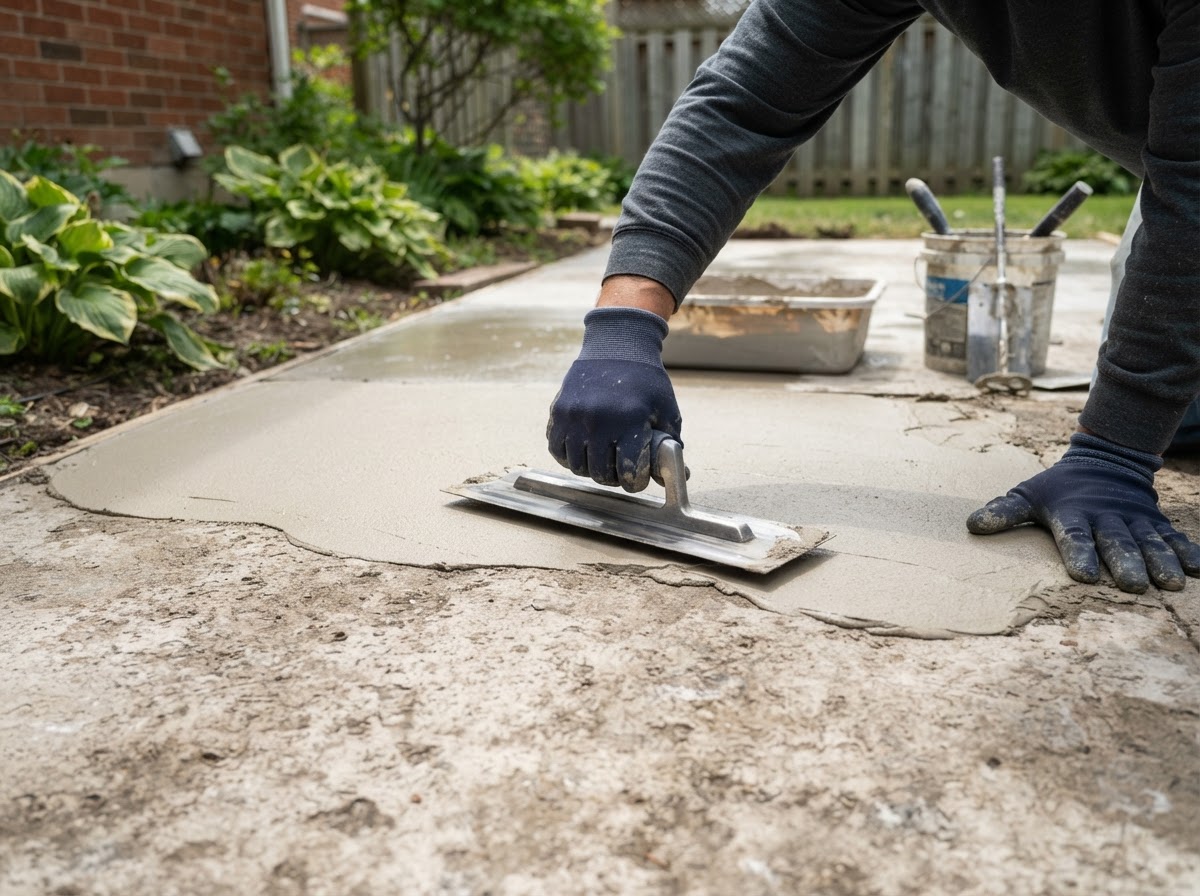
Driveway resurfacing renews the visible surface of a suitable existing concrete driveway rather than removing and replacing the full slab. A resurfacing or overlay system is applied over a prepared, stable substrate to create a fresh, consistent finish that addresses surface-level wear without the demolition and reconstruction of a full replacement.
Resurfacing requires a reasonably stable underlying slab. It is not a fix for structural failure, widespread deep cracking, ongoing settlement, or a failed base. An overlay bonds to the surface beneath it, so whatever movement, cracks, and drainage problems exist underneath will telegraph through and shorten the life of the new surface. That is why the slab condition is evaluated before resurfacing is recommended — not after.
Common reasons to consider driveway resurfacing include surface wear, light scaling, discoloration, cosmetic deterioration, an aging appearance, and suitable minor surface defects. Where the damage is isolated to a few spots, targeted repair is usually more economical; where the slab is unstable or the failure is structural, replacement is the more durable call. Resurfacing fits the middle ground: a sound slab whose surface has aged faster than its structure.
When a Driveway May Be Suitable for Resurfacing
Whether a driveway is a resurfacing candidate depends on the condition of the slab, not just the surface. A stable slab with primarily surface-level deterioration is the classic resurfacing prospect; an unstable or structurally failed slab is not.
Possible Resurfacing Candidates
- Stable slab with no significant structural cracking or movement
- Primarily surface-level deterioration — wear, fading, or cosmetic aging
- Worn finish that has lost texture but not integrity
- Cosmetic discoloration from age, staining, or weathering
- Minor surface scaling limited to the top layer
- Previous surface wear without deep or widespread cracking
Poor Resurfacing Candidates May Include
- Severe settlement or sunken panels with elevation differences
- Widespread structural cracking across most of the slab
- Unstable slab movement or heaving
- Major broken sections or lost edges
- Severe base failure or extensive heaving
The right direction depends on what is actually happening with the slab. Surface wear points toward resurfacing; a localized crack points toward repair; a settled section points toward leveling; and major slab failure points toward replacement. Matching the solution to the real condition is what makes the result last.
| Condition | Possible Direction |
|---|---|
| Surface wear | Resurfacing evaluation |
| Localized crack | Repair evaluation |
| Settled section | Leveling evaluation |
| Major slab failure | Replacement evaluation |
How Driveway Resurfacing Is Completed
A durable resurfacing result depends on surface preparation as much as on the overlay material. An overlay applied over a contaminated, unsound, or unstable surface will delaminate and fail, so the process starts with evaluating and preparing the existing slab.
- 1Inspect the existing slab — assess stability, cracking, movement, and overall condition.
- 2Evaluate cracks and movement — determine which are surface-level and which indicate deeper problems.
- 3Assess drainage — check whether water is pooling or running beneath the slab.
- 4Clean and prepare the surface — remove dirt, oil, debris, and loose material.
- 5Remove weak or loose material — cut back unsound concrete so the overlay bonds to sound substrate.
- 6Repair suitable localized defects — address cracks or spalled areas that would telegraph through the overlay.
- 7Prepare for the overlay system — profile the surface as the selected system requires.
- 8Apply the resurfacing material — place the overlay or topping at the thickness the system specifies.
- 9Texture and finish — match the intended surface texture and traction.
- 10Cure according to the selected system — allow the material to gain strength before vehicle traffic returns.
We do not specify proprietary products or provide do-it-yourself mix instructions. The resurfacing system, thickness, and preparation method depend on the slab condition and the product selected for the project.
Resurface, Repair, Level, or Replace the Driveway?
Resurfacing is one of several approaches, and the right one depends on the actual condition of the slab. Each option addresses a different problem:
When Each Approach Makes Sense
- Repair — localized defects: an isolated crack, one broken corner, or a small spalled area on an otherwise stable slab.
- Resurface — a stable slab with surface-level wear, minor scaling, or cosmetic aging across most of the driveway.
- Level — one or more panels have settled but the concrete is intact and suitable for lifting.
- Partial replacement — an isolated section has failed badly enough that patching will not hold, but the rest is sound.
- Full replacement — widespread cracking, ongoing settlement, a failed base, or extensive structural deterioration.
Resurfacing is not a substitute for repair or replacement. It does not stop active movement, close structural cracks, or lift a settled slab — it renews the surface of a slab that is already sound enough to preserve. Where the slab is not suitable, resurfacing will not perform and we will say so.
Comparing options? See our resurfacing vs. replacement guide and repair vs. replacement guide.
Maryland Weather & Driveway Resurfacing
Maryland's climate shapes both why driveways surface-wear and how resurfacing performs. Freeze-thaw cycles through the winter mean moisture that enters the surface expands as it freezes, stressing the top layer and contributing to scaling. Deicing salts tracked onto the driveway from the street accelerate surface deterioration and discoloration, which is a common reason homeowners consider resurfacing in the first place.
Drainage matters as much for a resurfaced driveway as for a new one. Water that runs beneath the slab or pools at the garage entry erodes the base and contributes to movement, and a moving slab will crack an overlay from below. Resurfacing should not be used to conceal unresolved movement or drainage problems — the overlay will reflect whatever is happening underneath. Where drainage is the underlying issue, addressing it is part of the scope, not separate from it.
Sealing helps protect a resurfaced surface from moisture, deicing salts, and wear, and periodic resealing extends the life of the finish. We do not promise a maintenance-free or stain-proof surface; a resurfaced driveway still requires care to perform well through Montgomery County seasons.
Related resources: Maryland freeze-thaw and deicing guide and drainage and water management guide.
Not sure whether resurfacing or replacement makes more sense for your driveway? Request a driveway evaluation and we will assess the slab condition honestly.
Discuss Your Concrete Project
Have questions about scope, timing, or whether repair or replacement is the right call? We are happy to review your project and provide a clear, honest estimate.
Concrete Driveway Resurfacing FAQs & Estimates
Can an old concrete driveway be resurfaced?
Sometimes. An older driveway can be resurfaced when the underlying slab is stable and the deterioration is primarily surface-level — wear, fading, light scaling, or cosmetic aging. If the slab has structural cracking, ongoing settlement, or a failed base, resurfacing will not hold and repair or replacement is the better call. We assess the slab condition before recommending resurfacing.
Can cracked driveways be resurfaced?
It depends on the cracks. Minor, non-structural surface cracks on a stable slab may be addressed as part of surface preparation before resurfacing. Wider structural cracks, moving cracks, or widespread cracking indicate problems beneath the surface that an overlay will not solve — those driveways typically need repair or replacement first. We evaluate whether the cracks are surface-level or structural before recommending resurfacing.
Can resurfacing fix spalling?
Resurfacing can address spalling when it is limited to the surface layer and the slab beneath is sound. The loose material is removed, the surface is prepared, and the overlay renews the finish. Where spalling is extensive or the deterioration runs deeper, the slab may not be a suitable resurfacing candidate and replacement may be more durable. We assess the depth and extent before recommending an approach.
Is resurfacing the same as driveway repair?
No. Resurfacing renews the surface across most of the driveway and is suited to a stable slab with surface-level wear. Repair targets specific localized defects — an isolated crack, a broken corner, or a small spalled area — and leaves the rest of the surface untouched. The two address different conditions, and we recommend the one that fits the actual state of your driveway.
When should a driveway be replaced instead of resurfaced?
Replacement is typically the better choice when cracking is widespread across most of the slab, settlement is ongoing, the base has failed, or the concrete shows extensive structural deterioration. Resurfacing only works on a slab that is stable enough to preserve; when the structure itself has failed, an overlay will not perform. We are straightforward about when replacement is the more durable call.
Will resurfacing change the driveway appearance?
Yes — resurfacing creates a fresh, consistent surface finish that can improve the appearance of a worn or discolored driveway. The available texture and finish depend on the resurfacing system selected. We do not promise that a resurfaced surface will perfectly match the original or look identical to a brand-new pour, but it renews the visible surface without full demolition.
What affects driveway resurfacing cost?
Resurfacing cost depends on the driveway's square footage, the extent of surface deterioration, the surface preparation required, any localized repairs needed before the overlay, the resurfacing system selected, drainage work, and site access. Because every driveway differs, we provide project-specific estimates rather than fixed per-square-foot rates.
Request a Concrete Driveway Resurfacing Estimate
Wondering whether your driveway is a good resurfacing candidate? Gaithersburg Concrete will evaluate the slab condition and give you an honest recommendation — resurface, repair, level, or replace. Call (240) 690-6035 or request a free estimate.
Related Concrete Services Near Gaithersburg
Concrete Resurfacing & Concrete Overlays
Restorative polymer-modified micro-toppings and decorative cement overlays for structurally sound yet worn concrete.
Learn moreConcrete Driveway Installation & Replacement
Durable residential and light commercial concrete driveways built to withstand vehicular weight and Maryland freeze-thaw cycles.
Learn moreConcrete Driveway Repair
Concrete driveway repair for localized cracks, broken edges, spalling, failed joints and single settled panels on otherwise sound driveways.
Learn moreConcrete Leveling, Lifting & Mudjacking
Cost-effective lifting of sunken, uneven concrete slabs to eliminate trip hazards and restore positive drainage.
Learn moreRequest a Concrete Driveway Resurfacing Estimate
Wondering whether your driveway is a good resurfacing candidate? Gaithersburg Concrete will evaluate the slab condition and give you an honest recommendation — resurface, repair, level, or replace. Call (240) 690-6035 or request a free estimate.
- Project-specific estimates — no obligation
- Residential and commercial concrete work
- Serving Gaithersburg and surrounding Montgomery County
Request a Free Estimate
Tell us about your concrete project in Gaithersburg or nearby.