Concrete Dumpster Pads in Gaithersburg, MD
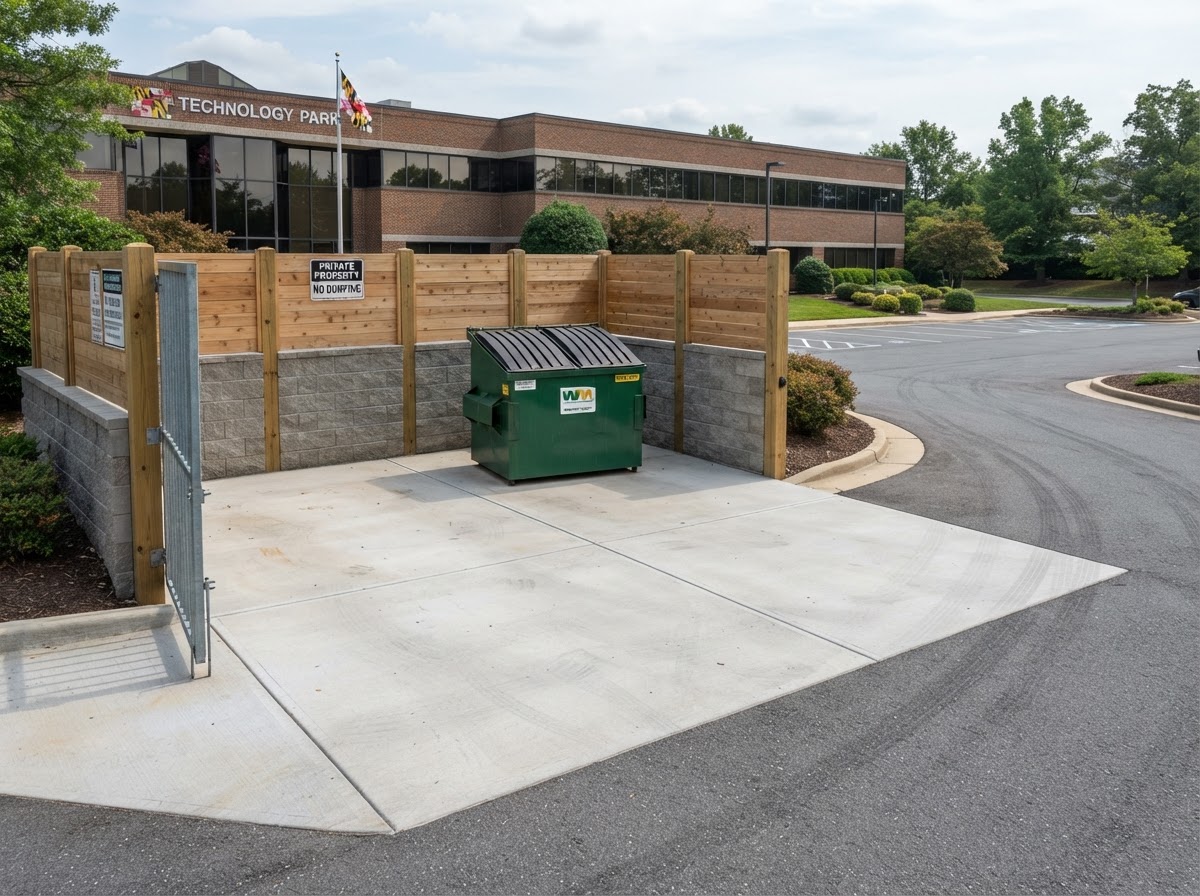
A concrete dumpster pad is a heavy-duty slab built to take the concentrated wheel loads, repeated container placement, and service-truck traffic that a commercial refuse area sees every week. Gaithersburg Concrete installs and replaces concrete dumpster pads and trash enclosure slabs for commercial properties across Gaithersburg, Maryland and surrounding communities, planning the slab, base, drainage, and access around the container type and how the pad is actually serviced. A dumpster pad experiences heavier concentrated loads than ordinary pedestrian flatwork — the truck that lifts or loads the container, the container itself, and the impact of repeated placement all act on a relatively small slab — so the dimensions, thickness, reinforcement, and edges are planned for that duty rather than treated like a walkway. Every dumpster pad project starts with a review of the container type, the servicing method, and the site access the truck needs to reach the pad.
Request a Free Estimate
Tell us about your concrete project in Gaithersburg or nearby.
Concrete Dumpster Pads in Gaithersburg
A concrete dumpster pad is the slab a commercial container sits on and the service truck works over. In Gaithersburg and across Montgomery County, these pads serve commercial refuse areas, trash enclosures, and dumpster areas at properties where a container is emptied on a regular schedule by a front-loader or rear-loader truck.
What makes a dumpster pad different from ordinary flatwork is the loading. A loaded container, the truck that services it, and the repeated placement of the container all concentrate force on a slab that is often smaller than a parking stall. The wheel loads from a service truck, the impact of setting the container down, and the abrasion of sliding it all act on the same surface week after week.
This page focuses on the concrete dumpster pad itself — the slab, the base, the edges, and the drainage — rather than the enclosure framing or the container. Where an enclosure, gate, or bollards are part of the project, those are coordinated with the pad so the whole refuse area works together.
Why Dumpster Pads Need Heavy-Duty Concrete Planning
A dumpster pad fails when it is built like light flatwork and then asked to carry service-truck traffic. The most common problems come from underestimating the loads the pad will see.
What a Dumpster Pad Has to Handle
- Front-loader or rear-loader truck access and the wheel loads that brings
- Repeated truck loading cycles as the container is emptied
- Container contact and the impact of repeated placement
- Wheel loads concentrated on a relatively small slab
- Broken edges where the container or truck strikes the slab perimeter
- Slab cracking from loads the base was not prepared to carry
- Settlement when the base was not compacted for the service traffic
- Inadequate drainage that leaves water standing in the refuse area
- Failed older pads that were poured too thin or over a poor base
Requirements depend on the container type, the servicing method, and the property layout. A pad built for a rear-load container serviced by a truck that backs in is planned differently than one for a front-load container lifted over the truck cab, and a pad inside an enclosure has different access and clearance considerations than a freestanding one. We do not assume one dumpster system — we plan around the container and truck the property actually uses.
Dumpster Pad Installation & Replacement Process
A dumpster pad follows the same pour sequence as other commercial flatwork, with extra attention to the base, the edges, and the access the service truck needs. A pad poured over an unprepared base is the most common reason a dumpster pad cracks early.
- 1Site review — confirm the pad location, access, and enclosure layout.
- 2Container and service-method review — plan around the container type and truck.
- 3Dimensions — set the pad size to the container and maneuvering clearance.
- 4Existing concrete removal where needed — break up and haul away a failed pad.
- 5Excavation — remove soil to the depth needed for base and slab.
- 6Subgrade and base preparation — compact the soil and add base material.
- 7Forming — set forms to the pad dimensions, thickness, and edges.
- 8Reinforcement based on requirements — add reinforcement suited to the loads.
- 9Concrete placement — pour and spread the concrete across the pad.
- 10Finishing — apply a finish suited to service traffic and traction.
- 11Joints — place control joints so the slab cracks where intended.
- 12Curing — allow the concrete to gain strength before the container returns.
- 13Access reopening — coordinate when the pad can go back into service.
We do not prescribe a universal thickness or reinforcement schedule. The slab thickness and reinforcement for a dumpster pad depend on the container type, the service truck, the base conditions, and the project requirements — a pad for a small rear-load container is not built the same as one for a heavy front-load system.
Truck Loads, Pad Dimensions, Edges & Drainage
A dumpster pad is designed around the truck that services it and the container that sits on it. The wheel loads, the container dimensions, and the enclosure layout all shape the slab, and the edges and apron are planned so the truck can reach the pad without damaging it.
Design Factors
- Wheel loads from the service truck and where they fall on the slab
- Service-truck approach and the turning clearance the truck needs
- Container dimensions and the pad size that supports them
- Enclosure dimensions and the clearance around the container
- Slab edges built to resist impact from the container and truck
- Apron areas where the truck stops and loads
- Gate transitions and enclosure clearance where applicable
- Surrounding pavement and how the pad ties into it
- Drainage and slope so water sheds off the refuse area
- Impact areas where the container is repeatedly set down
- Bollard coordination where posts protect the enclosure or walls
For broader commercial flatwork, see our commercial concrete and flatwork page; for the parking pavement around a refuse area, our concrete parking lots page. Existing concrete removal is handled through concrete demolition, protective posts are covered in our concrete bollards page, and the curbs and edges are addressed in our concrete curb and gutter services.
Repair or Replace a Damaged Dumpster Pad?
A dumpster pad in Gaithersburg sits outside through every Maryland season, which means freeze-thaw cycles, deicing materials, and the constant heavy truck traffic of a commercial refuse area all act on the slab. Water that stands in the refuse area, salt tracked in by the service truck, and edge spalling from container impact all shorten a pad's service life.
Whether a damaged pad can be repaired or needs to be replaced depends on how widespread the damage is and whether the slab is still stable. Localized surface damage on an otherwise sound pad can often be repaired; failed sections can be partially replaced; and a pad with widespread cracking, settlement, or severe deterioration usually needs full replacement.
Why Do Dumpster Pads Crack?
Dumpster pads crack for a combination of reasons: concentrated service-truck wheel loads the slab was not thickened to carry, poor base support or settlement beneath the pad, joint deterioration that lets the panels move independently, and weather exposure that drives freeze-thaw damage into the surface. The cause matters because repairing the surface without addressing the loading or the base means the crack returns. We assess the cause before recommending a scope.
Larger or structurally significant refuse-area slabs may require project-specific engineering, approvals, or permits depending on the jurisdiction, property, and scope. We do not invent thresholds — applicable requirements depend on the property, project scope, and jurisdiction.
Discuss Your Concrete Project
Have questions about scope, timing, or whether repair or replacement is the right call? We are happy to review your project and provide a clear, honest estimate.
Concrete Dumpster Pad FAQs & Estimates
How thick should a concrete dumpster pad be?
Dumpster pad thickness depends on the container type, the service truck that loads it, the base conditions, and the project requirements. A pad for a heavy front-load container serviced by a large truck is built differently than one for a small rear-load container. We recommend thickness based on the actual loads rather than a universal dimension.
Why are dumpster pads thicker than normal slabs?
Dumpster pads carry concentrated service-truck wheel loads, repeated container placement, and container impact that ordinary pedestrian flatwork does not. The heavier loading is why the slab, base, and edges are planned for that duty rather than treated like a walkway. A pad poured at light-slab thickness is the most common reason a dumpster pad cracks early.
Can an old dumpster pad be replaced?
Yes. A cracked, settled, or deteriorated dumpster pad can be removed and replaced, with the old concrete demolished and the base reprepared before the new slab is poured. Replacement also gives a chance to correct drainage, dimension, or access problems the original pad had. We assess whether the existing pad can be repaired or should be replaced before recommending a scope.
Can only part of a dumpster pad be repaired?
Yes, when the damage is localized and the surrounding slab remains stable. A broken edge or a single cracked section on an otherwise sound pad can often be repaired or partially replaced without removing the whole slab. Where damage is widespread or the base has failed, full replacement is typically the more durable option.
Does a dumpster pad need reinforcement?
Reinforcement is specified based on the container loads, service-truck traffic, base conditions, and project requirements. A pad under heavy service traffic often benefits from reinforcement to manage cracking and distribute the loads, while a lighter-use pad may not require the same approach. We place reinforcement per the project requirements rather than applying one schedule universally.
How is drainage handled around a dumpster pad?
Drainage is handled through slope and grading so water sheds off the refuse area rather than pooling on or around the pad, with surrounding drainage coordinated where the pad ties into pavement or a curb. Standing water in a refuse area accelerates deterioration and creates maintenance problems, so the slope is planned during the scope review. We do not claim to provide underground plumbing beyond the concrete drainage work in the agreed scope.
What affects dumpster pad installation cost?
Cost depends on the pad dimensions, slab thickness, reinforcement, demolition of an existing pad, excavation, base preparation, drainage work, site access, and any bollard or enclosure coordination. A larger pad under heavier service traffic with more preparation costs more than a small freestanding pad. We provide project-specific estimates based on the actual container, truck, and site.
Request a Commercial Dumpster Pad Estimate
If you need a new concrete dumpster pad installed or a damaged one replaced, Gaithersburg Concrete will review the container type, service method, drainage, and access, then provide a clear estimate. Serving Gaithersburg and surrounding Montgomery County communities.
Related Concrete Services Near Gaithersburg
Commercial Concrete & Concrete Flatwork
High-spec flatwork for commercial centers, retail plazas, loading docks, dumpster pads, and multi-family communities.
Learn moreConcrete Parking Lot Installation & Replacement
Concrete parking lot installation and replacement for commercial properties, private parking areas, and heavy-duty paved surfaces with drainage and joint planning.
Learn moreConcrete Curb & Gutter Installation and Repair
Concrete curb and gutter installation, replacement, and repair for private and commercial sites.
Learn moreConcrete Demolition, Removal & Replacement
Concrete demolition, removal, haul-away, and replacement for driveways, patios, walkways, and slabs.
Learn moreConcrete Bollards & Protective Equipment Bases
Concrete bollard bases and protective equipment foundations for generators, HVAC, utility equipment, and building corners on commercial properties.
Learn moreConcrete Loading Dock Slabs & Loading Aprons
Concrete loading dock slabs, loading aprons, and truck service-area concrete planned around vehicle loads, transitions, drainage, and joint layout.
Learn moreRequest a Commercial Dumpster Pad Estimate
If you need a new concrete dumpster pad installed or a damaged one replaced, Gaithersburg Concrete will review the container type, service method, drainage, and access, then provide a clear estimate. Serving Gaithersburg and surrounding Montgomery County communities.
- Project-specific estimates — no obligation
- Residential and commercial concrete work
- Serving Gaithersburg and surrounding Montgomery County
Request a Free Estimate
Tell us about your concrete project in Gaithersburg or nearby.