Concrete Loading Dock Slabs & Loading Aprons in Gaithersburg, MD
A concrete loading dock slab and loading apron is the heavy-duty pavement a commercial facility relies on for truck access, delivery handling, and the repetitive traffic a loading area sees every day. Gaithersburg Concrete installs and replaces loading dock slabs, loading aprons, and truck service-area concrete for commercial properties across Gaithersburg, Maryland and surrounding communities, planning the slab, joints, drainage, and transitions around the vehicles and operations the area serves. Loading dock concrete is a distinct application from ordinary flatwork — these surfaces carry heavier vehicle loading, repetitive truck traffic, and forklift transitions that a parking stall or walkway does not, so the thickness, reinforcement, joints, and drainage are planned for that duty. Every loading area project starts with a review of the truck access, the dock height, the operations around the work, and the loads the surface will carry.
Request a Free Estimate
Tell us about your concrete project in Gaithersburg or nearby.
Concrete Loading Dock Areas in Gaithersburg
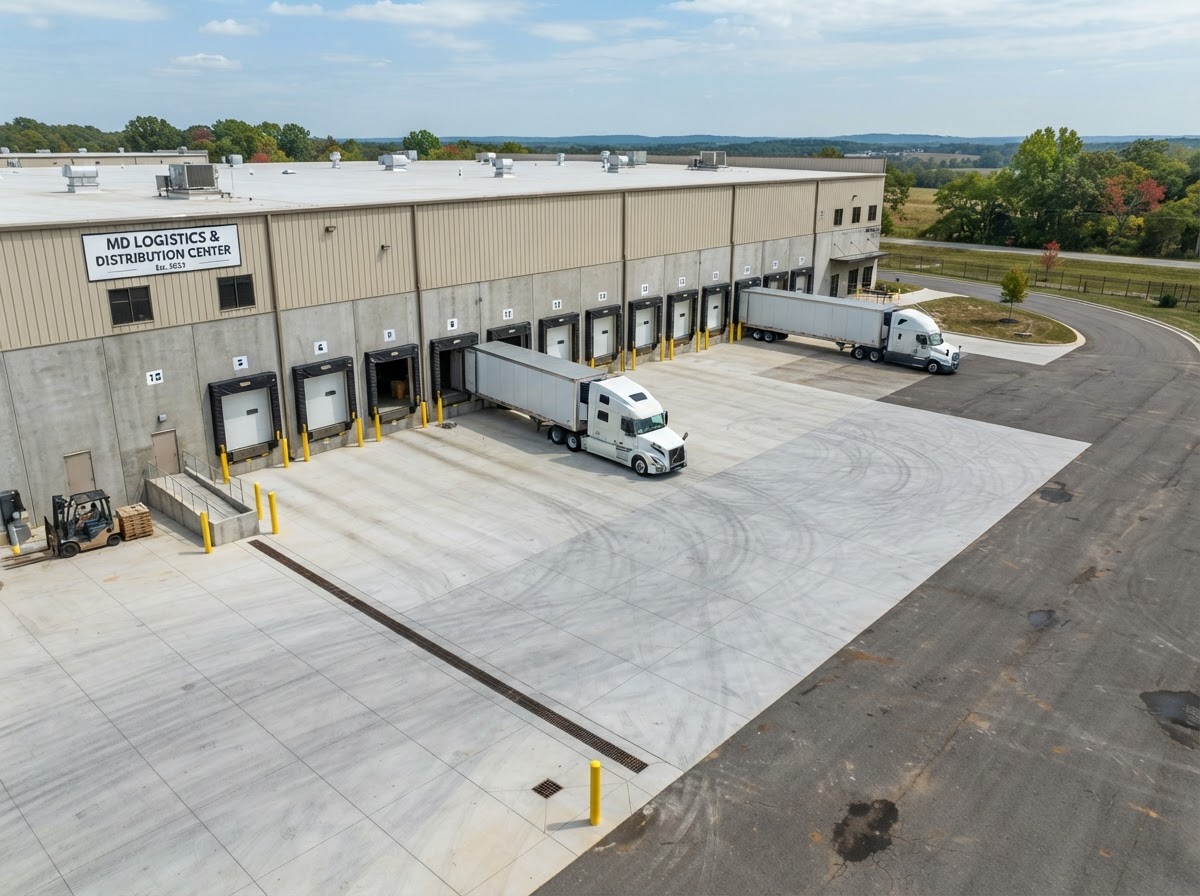
A loading dock is the transition between a building and the trucks that serve it, and the concrete around it — the dock slab, the loading apron, and the approach — is what carries that traffic. In Gaithersburg and along the I-270 corridor, loading dock concrete serves warehouse access, delivery areas, service yards, and truck maneuvering zones at commercial properties.
Loading aprons and dock approaches are the pavement trucks drive and turn on to reach the dock, and the transition slabs that connect the dock to the surrounding lot. These surfaces see heavier vehicle loading and repetitive traffic than parking stalls — the same trucks, the same paths, the same loads, day after day.
This page focuses on the concrete loading dock slab, the loading apron, and the service-area pavement around them. Where dock equipment, levelers, or seals are involved, that is a separate scope — here the focus is the concrete that carries the trucks and the operations.
Common Problems With Loading Dock Concrete
Loading dock concrete fails in patterns that reflect the repetitive, heavy traffic it carries. The problems show up where the loads concentrate and where the transitions happen.
Problems at a Loading Area
- Cracked slabs where truck loads have broken the pavement
- Failed joints that have opened up and broken down under traffic
- Edge damage where trucks strike or overrun the slab perimeter
- Settlement that has created uneven transitions for trucks and forklifts
- Spalling and surface deterioration from heavy traffic and exposure
- Impact damage from trailers, dollies, and equipment
- Uneven transitions between the dock, the apron, and the lot
- Water pooling where drainage has failed or was never planned
- Repeated truck loading that has broken down the surface over time
- Forklift transitions that stress the joints and edges
- Deteriorated dock approaches that no longer carry loads cleanly
Localized deterioration can affect vehicle movement and operations — a cracked apron or a settled transition slows loading, stresses equipment, and creates a safety issue for the people working the dock. We assess whether the damage is isolated to specific panels or widespread before recommending repair or replacement.
Loading Dock Slab Installation & Replacement Process
A loading dock project is planned around keeping the facility operating while the work happens. Phasing, staging, and the sequence of demolition and pours matter as much as the concrete itself, because a loading area is usually in use.
- 1Operational and site review — confirm truck access, dock height, and phasing needs.
- 2Truck access planning — keep a path open where the facility must stay operating.
- 3Demolition — break up and haul away the existing concrete where replacing.
- 4Phasing — sequence the work so the dock can operate around it.
- 5Excavation — remove soil to the depth needed for base and slab.
- 6Subgrade preparation — compact the soil to a stable surface.
- 7Base — add and compact base material for a stable foundation.
- 8Forms — set forms to the slab layout, thickness, and transitions.
- 9Reinforcement and specifications — add reinforcement per the project specs.
- 10Concrete placement — pour and screed the concrete section by section.
- 11Finishing — apply a finish suited to truck traffic and traction.
- 12Joints — place control and expansion joints for the loads.
- 13Curing — allow the concrete to gain strength before traffic returns.
- 14Reopening planning — coordinate when the loading area can return to use.
We do not promise a universal turnaround time. How long a loading area must stay closed depends on the concrete mix, the weather, the panel sizes, and the traffic the surface will carry — we plan a realistic reopening schedule during the scope review rather than giving a generic timeline.
Truck Loads, Dock Transitions, Drainage & Joint Planning
A loading dock slab is designed around the trucks that use it and the operations that happen on it. Tractor-trailers, delivery trucks, forklifts, and the transitions between the dock, the apron, and the lot each place different loads on the pavement, and the joints and drainage are matched to that traffic.
Design Factors
- Tractor-trailer loads where applicable and where they concentrate
- Delivery trucks and the everyday traffic the dock serves
- Dock height transition areas and the slab that supports them
- Loading apron geometry and the turning clearance trucks need
- Forklifts and the wheel loads they place on the slab
- Drainage — slope and water management across the apron
- Slab joints planned for the loads and the panel layout
- Adjacent pavement and how the apron ties into the lot
- Dock leveler coordination if relevant to the slab scope
- Curb transitions and the edges of the loading area
- Building thresholds and the slab-to-building connection
We do not claim to install dock equipment — levelers, seals, bumpers, and shelters are a separate scope unless agreed. Where dock equipment is involved, the concrete is coordinated with the equipment so the slab, the leveler pit, and the approach work together.
For broader commercial flatwork, see our commercial concrete and flatwork page; for the parking pavement around a loading area, our concrete parking lots page. Refuse-area slabs are covered in our concrete dumpster pads page, the curbs and edges in our concrete curb and gutter services, and existing concrete removal in our concrete demolition page.
Loading Area Concrete in Maryland
A loading dock in Gaithersburg faces freeze-thaw cycles, deicing salts, snow removal, and heavy traffic through every Maryland season. These surfaces see more wear than residential concrete because the use is heavier and more constant, and freeze-thaw cycles accelerate surface deterioration on slabs that are already under load.
Water and joint maintenance are recurring factors. Water that pools on the apron or runs beneath the slabs contributes to scaling, settlement, and joint deterioration, and deicing salts break down the surface over repeated winter use. Snowplows stress the joints and edges, and edge wear from plows and traffic accumulates over the years.
Repair vs. Replacement
Individual panels can often be repaired or replaced when the damage is isolated — a single cracked apron section or a failed joint on an otherwise sound dock can be addressed without rebuilding the whole area. Where the deterioration is widespread, the transitions have failed, or the base has settled broadly, broader reconstruction is usually the more durable path. We assess the condition before recommending a panel-by-panel or full-area approach.
Discuss Your Concrete Project
Have questions about scope, timing, or whether repair or replacement is the right call? We are happy to review your project and provide a clear, honest estimate.
Loading Dock Concrete FAQs & Estimates
What is a concrete loading apron?
A concrete loading apron is the pavement directly in front of a loading dock that trucks drive and turn on to reach the dock. It is the transition between the dock slab and the surrounding lot, and it is built to carry the repetitive truck traffic, turning loads, and forklift movement a loading area sees. The apron is planned around the truck access, the dock height, and the drainage the area needs.
Why does loading dock concrete crack?
Loading dock concrete cracks from the combination of heavy truck loads, repetitive traffic, joint deterioration, and base settlement. The same trucks on the same paths stress the slabs and joints day after day, and water that gets beneath the apron contributes to settlement and freeze-thaw damage. The cause matters because repairing the surface without addressing the loads or the base means the crack returns.
Can loading dock slabs be replaced in sections?
Yes. Loading dock slabs can often be replaced in sections — removing and repouring failed panels while the rest of the apron remains — when the overall pavement is still serviceable and only specific panels have failed. Where damage is widespread or the transitions have failed, broader reconstruction is usually the more durable path. We assess the condition before recommending a phased or full approach.
How thick should loading dock concrete be?
Loading dock concrete thickness depends on the traffic the dock serves — delivery trucks, tractor-trailers, or heavier service traffic — the base conditions, and the project specifications. An apron for delivery trucks is designed differently than one that sees tractor-trailers. We recommend thickness based on the actual loads rather than a universal dimension.
Does loading dock concrete require reinforcement?
Most loading dock concrete uses reinforcement specified by the project requirements, traffic loads, and base conditions. The reinforcement schedule follows the loads the apron will carry — delivery traffic, tractor-trailers, or forklifts. We place reinforcement per the project specifications rather than applying one schedule universally.
Can loading areas be repaired without shutting down the entire site?
Often yes. Loading area concrete can be phased so that part of the dock or apron stays in operation while another section is repaired or replaced, keeping a truck path open where the facility must keep running. How much can stay open depends on the layout, the scope, and the curing time the concrete needs before it carries traffic. We plan the phasing during the scope review.
What affects loading dock slab cost?
Cost depends on the slab area, thickness, reinforcement, demolition of existing concrete, base preparation, drainage work, joint layout, phasing requirements, site access, and any dock-equipment coordination. A larger apron under heavier traffic with phasing costs more than a small repair. We provide project-specific estimates based on the actual dock, trucks, and site.
Discuss Your Loading Dock Concrete Project
Whether you need a new loading apron poured or a deteriorated dock slab replaced, Gaithersburg Concrete will review the truck access, loads, drainage, and phasing, then provide a clear estimate. Serving Gaithersburg and surrounding Montgomery County communities.
Related Concrete Services Near Gaithersburg
Commercial Concrete & Concrete Flatwork
High-spec flatwork for commercial centers, retail plazas, loading docks, dumpster pads, and multi-family communities.
Learn moreConcrete Parking Lot Installation & Replacement
Concrete parking lot installation and replacement for commercial properties, private parking areas, and heavy-duty paved surfaces with drainage and joint planning.
Learn moreConcrete Dumpster Pads
Concrete dumpster pads and trash enclosure slabs built for service-truck traffic, container loads, and outdoor exposure on commercial properties.
Learn moreConcrete Curb & Gutter Installation and Repair
Concrete curb and gutter installation, replacement, and repair for private and commercial sites.
Learn moreConcrete Demolition, Removal & Replacement
Concrete demolition, removal, haul-away, and replacement for driveways, patios, walkways, and slabs.
Learn moreWarehouse & Industrial Concrete Floor Slabs
Warehouse and industrial concrete floor slabs planned around rack loads, forklift traffic, joint layout, and the finish a facility's operations require.
Learn moreDiscuss Your Loading Dock Concrete Project
Whether you need a new loading apron poured or a deteriorated dock slab replaced, Gaithersburg Concrete will review the truck access, loads, drainage, and phasing, then provide a clear estimate. Serving Gaithersburg and surrounding Montgomery County communities.
- Project-specific estimates — no obligation
- Residential and commercial concrete work
- Serving Gaithersburg and surrounding Montgomery County
Request a Free Estimate
Tell us about your concrete project in Gaithersburg or nearby.