Concrete Parking Pads & RV Pads in Gaithersburg, MD
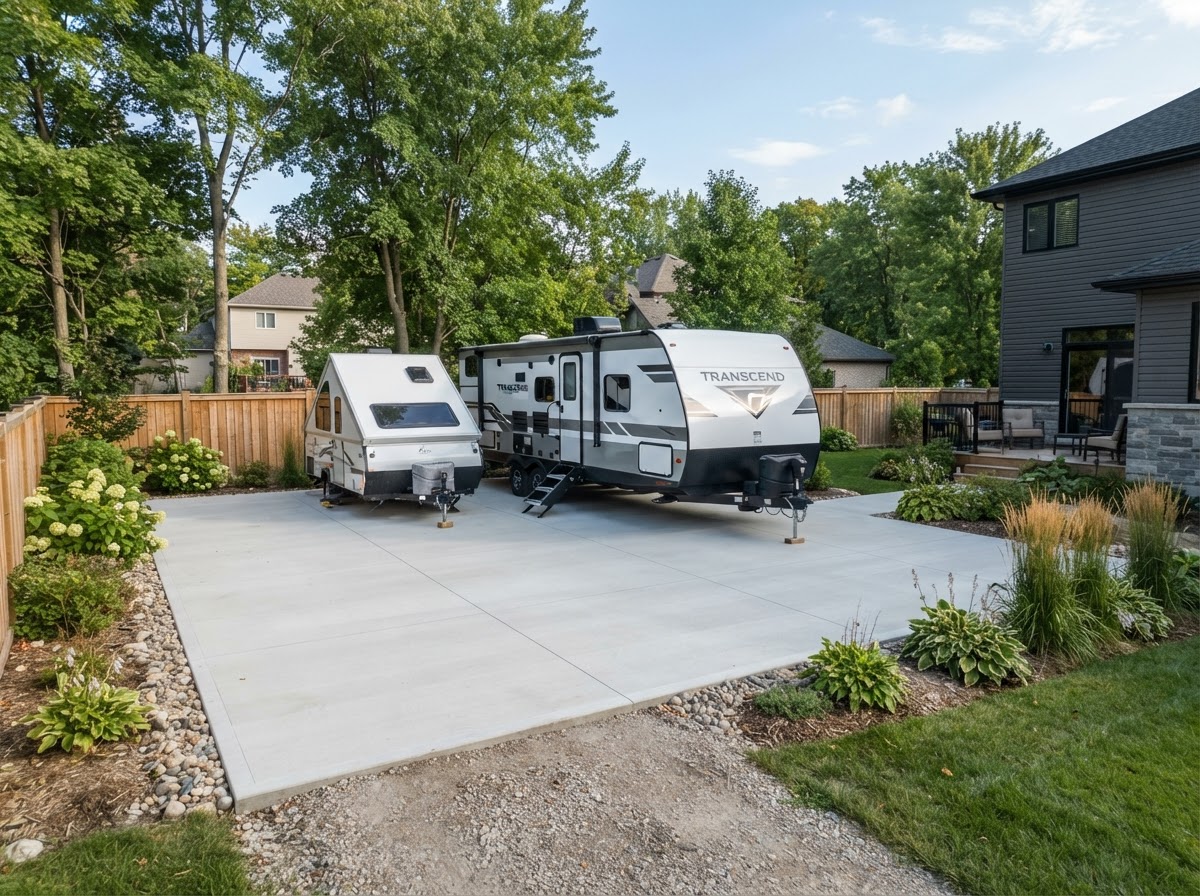
Concrete parking pads and RV pads give vehicles, trailers, and campers a flat, stable surface that holds up under real loads in Gaithersburg. Gaithersburg Concrete pours dedicated parking slabs for extra vehicles, RV storage, trailer parking, and overflow parking, with thickness, reinforcement, and base preparation matched to what the pad will actually carry. Unlike a patio or light-use slab, a parking pad is planned around vehicle weight, wheel loads, and maneuvering room — so the finished surface stays level under a motorhome, travel trailer, or daily driver. Every pad starts with a review of the vehicle type, intended loads, access, and site conditions.
Request a Free Estimate
Tell us about your concrete project in Gaithersburg or nearby.
Concrete Parking & RV Pads in Gaithersburg
A concrete parking pad is a dedicated slab built to carry a vehicle, trailer, or RV on a flat, stable surface rather than on grass, gravel, or bare soil. In Gaithersburg, where many lots have room for an extra vehicle but not a second full driveway, a parking pad is a practical way to add usable parking without reworking the whole front yard.
RV pads are the same idea sized and reinforced for the heavier, longer loads a motorhome, travel trailer, or camper brings. An RV puts concentrated weight down through its tires and leveling jacks, and it needs more length, width, and turning room than a passenger car. A pad built for an RV is planned around that load and those dimensions from the start.
Parking pads have different load and dimensional considerations than patios or light-use slabs. A patio carries people and furniture; a parking pad carries thousands of pounds of vehicle weight through small tire contact points, over and over. That is why thickness, reinforcement, base preparation, and drainage are planned around the vehicle — not borrowed from a lighter-use slab design.
When a Dedicated Concrete Parking Pad Is Useful
A dedicated parking pad is useful any time a household needs more vehicle space than the existing driveway provides, or when a vehicle should be kept off the lawn and soil. The most common uses around Gaithersburg involve additional daily vehicles and seasonal or recreational equipment.
Common Parking Pad Uses
- Keeping an additional household vehicle off the lawn or gravel
- RV storage so a motorhome or camper rests on a level, stable surface
- Trailer parking for utility trailers, boat trailers, or equipment trailers
- Work-vehicle parking that keeps a truck or van separate from the primary driveway
- Overflow parking for guests or a second household without widening the main driveway
- Connecting a new parking area to an existing driveway for one continuous surface
- Replacing a gravel or unstable parking area that ruts and shifts under vehicle weight
Not every lot allows RV parking, and we are honest about that. Zoning rules, HOA requirements, setback limits, and local requirements can restrict where a pad can go, how large it can be, or whether RV or trailer parking is permitted on the property at all. We plan the pad around what the property and applicable requirements allow rather than assuming any lot can take any vehicle.
Concrete Parking Pad Installation Process
A parking or RV pad is poured the same way as other flatwork, with the thickness, reinforcement, and base tuned to the vehicle it will carry. The process starts with understanding the load and ends with a slab that stays level under that load.
- 1Vehicle type and intended loads — confirm what the pad will carry, from a passenger car to a loaded RV.
- 2Layout — mark the pad dimensions, access, and any connection to the existing driveway.
- 3Access review — confirm equipment and concrete delivery can reach the pad location.
- 4Excavation — remove soil to the depth needed for base and slab.
- 5Base preparation — add and compact base material for a stable foundation.
- 6Grading — set the slope so water drains off the pad rather than pooling on it.
- 7Forming — set forms to the pad dimensions, thickness, and edges.
- 8Reinforcement where appropriate — add reinforcement suited to the vehicle load and conditions.
- 9Concrete placement — pour and screed the concrete to a consistent level.
- 10Finishing — apply a finish suited to vehicle use, typically a broom texture for traction.
- 11Joints — place control joints so the slab cracks where intended as it cures and moves.
- 12Curing — allow the concrete to gain strength before vehicles use the pad.
We do not prescribe a universal slab thickness because the right thickness depends on the vehicle. A pad for a compact car, a pad for a loaded travel trailer, and a pad for a Class A motorhome each carry different loads through different tire footprints, and the slab has to be matched to that load. We recommend thickness based on what the pad will actually support.
RV Pad Size, Load & Drainage Considerations
An RV pad has to fit the rig that will park on it. The length and width of the pad need to accommodate the vehicle plus some maneuvering room, the slab has to carry the vehicle's weight without settling, and the surface has to drain so water does not sit under a parked RV for months at a time.
RV Pad Planning Factors
- RV length and width, including slide-outs and overhang clearance
- Vehicle weight and how that load transmits through the tires
- Wheel loads and the concentrated weight at each tire contact point
- Trailer jack and stabilizer locations where point loads rest on the slab
- Maneuvering room and turning radius for getting the rig on and off the pad
- Slope set so water runs off rather than pooling beneath the vehicle
- Runoff directed away from the pad and any adjacent structures
- Adjacent structures and clearances so the pad fits the lot
Some RV owners want electrical hookup coordination on or near the pad. We handle the concrete flatwork — the slab, base, drainage, and finish — but we do not provide electrical work, and any power run to an RV pad should be coordinated with a qualified electrician and the applicable requirements. We plan the slab around the hookup location you specify rather than performing the electrical installation ourselves.
For the connected driveway, see our concrete driveway installation and driveway widening and extensions services. General-purpose slabs and pads are covered in our concrete slabs, pads and foundations page, and where an existing surface must be removed first, our concrete demolition and removal work handles the tear-out.
Concrete Parking Pads for Maryland Weather
A parking or RV pad in Gaithersburg faces the same freeze-thaw cycles as any exterior concrete, with the added demand of heavy vehicle weight. Moisture that enters the slab can expand as it freezes, stressing the surface and any cracks, while the concentrated load of a parked RV or trailer works the base beneath the slab all winter long. Proper base preparation and drainage are what keep the pad level under that combination of load and freeze-thaw.
Water management matters even more for an RV pad than for a lighter slab. A motorhome parked for the off-season traps moisture beneath it, and water that pools under the rig softens the base and leads to settlement under the tire and jack locations. Slope the pad so water moves off, direct roof and site runoff away from the slab, and the base stays stable enough to hold the vehicle level season after season.
Snow, deicers, and surface traction are part of the equation too. A broom finish gives a parked vehicle grip and gives you traction when walking around the rig in winter. Edge loading — where a tire rests right at the slab edge — is a common cause of cracking, so we size the pad so vehicles park on the interior of the slab rather than hanging a tire off the edge. Base settlement under a heavy RV shows up as a dipped slab, which is why compaction and base material are not the place to cut corners on a parking pad.
Concrete Parking Pad vs. Gravel Parking Area
A gravel parking area is cheaper up front but ruts under vehicle weight, holds water, and needs regular regrading — especially under an RV that sits in one spot for months. A concrete parking pad costs more to install but stays level, sheds water, and does not migrate or track gravel into the yard. For a vehicle that will park in the same spot repeatedly, concrete is the lower-maintenance choice; for occasional or light use, gravel may be enough. We help you weigh that trade-off for the specific vehicle and use.
Discuss Your Concrete Project
Have questions about scope, timing, or whether repair or replacement is the right call? We are happy to review your project and provide a clear, honest estimate.
Parking Pad & RV Pad FAQs & Free Estimates
How thick should a concrete RV pad be?
RV pad thickness depends on the vehicle weight, wheel loads, soil and base conditions, and whether the pad also carries leveling jacks. A motorhome puts far more load through its tires than a passenger car, so the slab is matched to that load rather than using a single thickness for every pad. We recommend thickness based on the specific RV and site rather than a universal dimension.
Can a parking pad connect to an existing driveway?
Yes. A parking pad can be tied into an existing driveway when the elevations, base, and drainage are planned to match, creating one continuous paved surface. The connection is detailed so the seam does not become a lip or a crack point. We plan the transition as part of the pour rather than leaving the pad as an isolated slab.
How large should an RV concrete pad be?
RV pad size depends on the rig's length and width, slide-out and overhang clearance, and the maneuvering room needed to get on and off the pad. A longer motorhome with slide-outs needs more length and side clearance than a small travel trailer. We size the pad to the actual RV plus reasonable access rather than a fixed dimension.
Does an RV pad need reinforcement?
Reinforcement is often appropriate for an RV pad because of the concentrated vehicle and jack loads, but it depends on the slab thickness, vehicle weight, and base conditions. A heavier RV on a thinner slab benefits more from reinforcement than a lighter trailer on a thicker pad. We recommend reinforcement where it suits the specific load and project.
Can concrete support a motorhome or travel trailer?
Yes, a concrete pad properly planned for the vehicle weight, tire loads, and jack locations can support a motorhome or travel trailer. The key is matching the thickness, reinforcement, and base to the actual load — a pad built for a passenger car may not hold up under a heavy RV. We size the pad to the rig it will carry.
Can a parking pad replace a gravel area?
Yes, a concrete parking pad is a common replacement for a gravel parking area that has rutted or spread. The existing gravel is removed or incorporated into the base, the subgrade is compacted, and the concrete pad is poured to a level, draining surface. Concrete stays level where gravel ruts and migrates under repeated vehicle weight.
What affects the cost of a concrete RV pad?
Cost depends on the pad dimensions, slab thickness, reinforcement, excavation and base preparation, drainage work, site access, and any demolition of existing gravel or concrete. A larger, thicker, reinforced pad for a heavy RV costs more than a smaller pad for a light trailer. We provide project-specific estimates based on the vehicle and site rather than fixed per-square-foot rates.
Request a Parking or RV Pad Estimate
Whether you need a parking pad for an extra vehicle or a reinforced slab for an RV or trailer, Gaithersburg Concrete will review the load, dimensions, and site, then provide a clear estimate. Serving Gaithersburg and surrounding Montgomery County communities.
Related Concrete Services Near Gaithersburg
Concrete Driveway Installation & Replacement
Durable residential and light commercial concrete driveways built to withstand vehicular weight and Maryland freeze-thaw cycles.
Learn moreConcrete Driveway Widening & Extensions
Concrete driveway widening and extensions that add usable parking width to an existing driveway without a full replacement.
Learn moreConcrete Slabs, Pads & Foundations
Heavy-duty concrete pads for backyard sheds, hot tubs, HVAC units, backup generators, and residential accessory structures.
Learn moreConcrete Demolition, Removal & Replacement
Concrete demolition, removal, haul-away, and replacement for driveways, patios, walkways, and slabs.
Learn moreRequest a Parking or RV Pad Estimate
Whether you need a parking pad for an extra vehicle or a reinforced slab for an RV or trailer, Gaithersburg Concrete will review the load, dimensions, and site, then provide a clear estimate. Serving Gaithersburg and surrounding Montgomery County communities.
- Project-specific estimates — no obligation
- Residential and commercial concrete work
- Serving Gaithersburg and surrounding Montgomery County
Request a Free Estimate
Tell us about your concrete project in Gaithersburg or nearby.