Concrete Repair Cost Guide for Gaithersburg, MD
Concrete repair costs vary because the word repair can mean very different things — from sealing a localized crack to patching spalled concrete, leveling a sunken slab, or replacing a failed section. This guide from Gaithersburg Concrete explains what affects concrete repair pricing in Gaithersburg, how diagnosis and repair type drive cost more than square footage alone, and what information helps produce a more accurate estimate. Rather than publish fixed prices, we walk through the variables that shape a repair quote so homeowners and property managers can understand why one crack costs less to address than widespread slab failure, and when repair, leveling, resurfacing, or full replacement each make sense.
Request a Free Estimate
Tell us about your concrete project in Gaithersburg or nearby.
How Much Does Concrete Repair Cost in Gaithersburg?
Concrete repair costs vary because concrete repair can mean very different things — from sealing a localized crack to patching spalled concrete, leveling a sunken slab, or replacing a failed section. Diagnosis and repair type drive cost more than square footage alone, which is why two repairs of similar size can carry meaning different scope.
What Drives Repair Cost
- Problem type — crack, spalling, settlement, joint failure, broken edge
- Damage severity and extent
- Repair area and how much concrete is affected
- Crack width, depth, and whether movement is active
- Slab movement and settlement
- Spalling depth and surface deterioration
- Site access for equipment and material
- Repair material selected for the defect
- Surface preparation required
- Exposed reinforcement where applicable
- Underlying drainage problems
- Whether replacement of a section is needed
A hairline crack on a stable driveway is a small, focused repair. A slab with widespread cracking, active settlement, and a failed base is a different project entirely — and the cost reflects that difference. We do not publish fabricated per-square-foot repair prices, because real repair cost reflects the diagnosis and method rather than a flat rate.
What Affects Concrete Repair Pricing?
Each repair problem carries its own scope. Understanding what drives each helps you compare estimates and see why one quote may differ from another for what looks like the same damage.
| Problem | Typical Repair Approach | Main Scope Factors |
|---|---|---|
| Cracks | Crack preparation, sealing, or injection | Width, length, active movement, surface prep |
| Joints | Joint repair, sealant replacement | Joint condition, material removal, resealing |
| Spalling | Remove unsound material, patch | Depth, area, edge preparation, repair material |
| Sunken slab | Leveling or lifting where the slab is sound | Slab condition, lift method, void filling, access |
| Broken edge | Edge repair or partial replacement | Extent, forming, finish matching |
| Surface deterioration | Resurfacing or overlay where the slab is stable | Surface prep, overlay material, area |
| Failed panel | Partial or full replacement | Demolition, disposal, base, new pour |
The repair approach is matched to the actual condition. A crack that is still moving will not hold a surface patch, and a slab with a failed base will not stay level after lifting. We assess the cause before recommending a method, because repairing the symptom without addressing the cause leads to recurring damage.
Different Concrete Repairs Have Different Cost Structures
Crack Repair
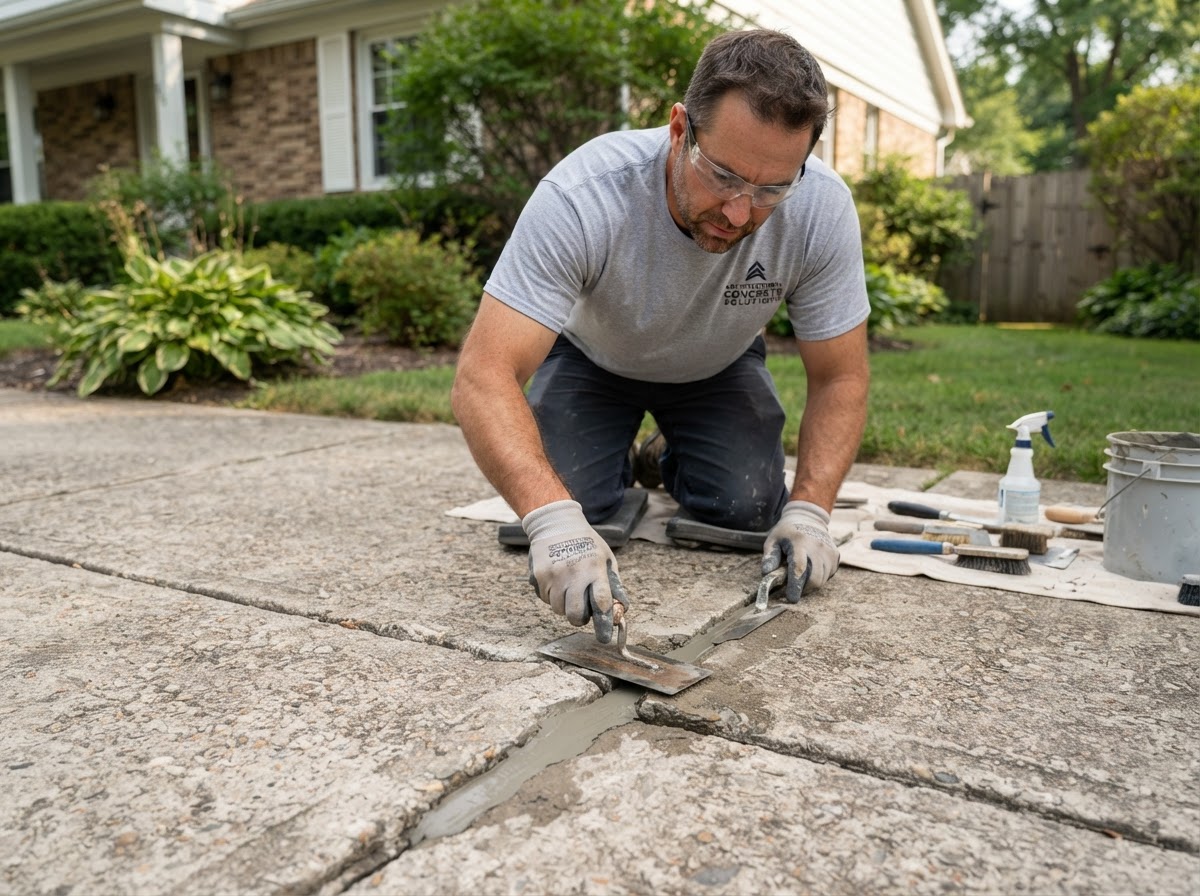
Crack repair involves preparing the crack, cleaning it, and filling or sealing it with a material suited to the width and type. It is typically the smallest scope when the crack is localized and the slab is stable.
Joint Repair
Joint repair addresses failed sealant or joint material — removing the old material, cleaning the joint, and replacing it. Failed joints let water and debris beneath the slab, so restoring them protects the surrounding concrete.
Spalling Repair
Spalling repair removes the loose, unsound concrete down to stable material, prepares the edges, and patches with a compatible repair material. The depth and area of the spalling drive the scope.
Leveling
Leveling raises a settled but intact slab back toward grade, typically by injecting material beneath it to fill voids and lift the panel. It is less scope than replacement but only suitable when the slab is structurally sound.
Resurfacing
Resurfacing renews a stable but cosmetically worn surface with an overlay or topping. It is less scope than replacement but only appropriate when the existing slab is sound — a surface with major cracking or settlement needs repair or replacement first.
Partial Replacement
Partial replacement removes a failed slab section, reprepares the base, and pours a new section tied into the surrounding concrete. It is more scope than repair but less than full replacement when the damage is confined.
Full Replacement
Full replacement reconstructs an extensively failed slab from the base up. It is the largest scope but the most durable option when the existing concrete can no longer provide a dependable base for repair.
For the service pages behind each, see our concrete repair, spalling repair, crack and joint repair, leveling, and resurfacing pages.
Repair Cost vs. Replacement Cost
The lowest initial repair cost is not always the most practical long-term choice. When damage is localized and the slab is stable, repair is usually the right call. When cracking, settlement, or deterioration is widespread, or the base has failed, a series of repairs rarely holds up as well as a new pour.
Factors in the Repair-vs.-Replacement Decision
- Extent of damage — localized versus widespread
- Whether movement is active or has stopped
- History of repeated repairs that have failed
- Condition of the underlying base
- Drainage problems contributing to the damage
- Surface deterioration across the slab
- Remaining usable slab area
- Desired appearance consistency
A single crack on an otherwise sound driveway is a repair. A driveway with cracks running through most of the panels, settlement across the field, and a base that has eroded is a replacement. The decision is based on the actual condition, not on which option is easier to sell — and our dedicated repair vs. replacement guide walks through the framework in detail.
For the full decision framework, see our concrete repair vs. replacement guide.
Maryland Conditions That Can Affect Repair Scope
Maryland's climate amplifies several causes of concrete damage. Freeze-thaw cycles through the winter mean moisture that enters cracks, joints, or the base can expand as it freezes, stressing the surface and widening existing damage. Deicing salts accelerate surface scaling, and poor drainage lets water run beneath slabs and contribute to settlement.
Soil and base movement is a recurring factor. The subgrade beneath a slab shifts with wet and frozen cycles, and a poorly prepared or eroded base takes the slab with it — cracks appear, edges drop, and panels settle. Repairing the visible damage without addressing the underlying water or movement may not solve the cause, which is why diagnosis comes before a repair method.
Surface scaling from winter deicing exposure is common on older exterior concrete. Where the surface has scaled but the slab is structurally sound, resurfacing may renew it; where the scaling runs deeper or the slab has cracked through, repair or replacement is more appropriate. We assess the depth and cause before recommending a scope.
How to Prepare for a Concrete Repair Estimate
Information to Gather
- Photograph the damage from multiple angles
- Note when the problem started and whether it is worsening
- Identify whether a crack is changing — widening, lengthening, or shifting
- Note any standing water or drainage issues nearby
- Identify trip hazards or uneven sections
- Note any previous repairs and how they performed
- Note deicing exposure on the surface
- Measure the affected area
- Explain the intended use of the surface
For the service pages, see our concrete repair, spalling repair, crack and joint repair, leveling, and resurfacing pages. For the broader pricing framework, see our overall concrete cost guide.
Discuss Your Concrete Project
Have questions about scope, timing, or whether repair or replacement is the right call? We are happy to review your project and provide a clear, honest estimate.
Concrete Repair Cost FAQs & Estimates
Why does concrete repair pricing vary?
Repair pricing varies because concrete repair can mean very different things — a localized crack, spalling, a sunken slab, or a failed section each carry different scope. Diagnosis and repair type drive cost more than square footage alone, which is why a site-specific estimate is more accurate than a flat rate.
Is crack repair cheaper than replacement?
Usually, when the crack is localized and the slab is stable. A single crack on an otherwise sound surface is a focused, lower-scope repair. When cracking is widespread or the slab has failed, replacement is often the more practical long-term value.
Can spalling concrete be repaired?
Yes. Spalled and flaking surfaces can often be repaired by removing the loose, unsound material down to stable concrete and patching with a compatible repair material. The repair's longevity depends on addressing the cause of the spalling — often moisture or freeze-thaw exposure — not just covering the surface.
Does concrete leveling cost less than replacement?
Typically yes, when the slab is structurally sound and only settled. Leveling raises a settled panel back toward grade by filling voids and lifting it, which is less scope than demolition and a new pour. When the slab is cracked through or the base has failed, replacement is usually the better option.
Does the size of the repair matter?
Yes, but less than the type and cause. A small area of deep spalling or an active crack may cost more to address properly than a larger area of stable, surface-level wear. The repair method and whether the cause is still active matter more than square footage alone.
Can repairing drainage reduce recurring damage?
Yes. When water running beneath a slab or pooling against it is the underlying cause of cracking or settlement, correcting the drainage is part of a durable repair. Repairing the visible damage without addressing the water often leads to the same problem returning.
When is concrete too damaged to repair?
When cracking is widespread, settlement is ongoing, the base has failed, or the slab shows extensive structural deterioration, replacement is typically the more durable option. Continuing to patch a slab that is failing throughout rarely holds up as well as a new pour.
How do I request a repair estimate?
Call (240) 690-6035 or request a free estimate through our contact page. We assess the damage type, whether movement is active, and the underlying cause, then recommend a repair, leveling, resurfacing, or replacement scope with a project-specific estimate.
Request a Concrete Repair Evaluation
Not sure whether your damaged concrete can be repaired or needs replacement? Gaithersburg Concrete will assess the condition, identify the cause, and give you an honest recommendation with a clear estimate. Call (240) 690-6035 or request a free estimate.
Keep Learning About Concrete in Gaithersburg
Concrete Cost Guide for Gaithersburg, MD
What affects concrete project costs in Gaithersburg — size, demolition, access, base, thickness, reinforcement, finish, grading and drainage.
Read the guideConcrete Driveway Cost Guide for Gaithersburg, MD
What changes concrete driveway cost in Gaithersburg — dimensions, removal, base, thickness, reinforcement, drainage and finish.
Read the guideConcrete Repair vs. Replacement: How to Decide
A decision framework for repairing or replacing damaged concrete in Gaithersburg — cracking, settlement, spalling, movement and slab condition.
Read the guideRelated Concrete Services Near Gaithersburg
Concrete Repair & Crack Repair
Targeted structural crack filling, spalling remediation, and damaged section patching to extend concrete longevity.
Learn moreSpalling, Flaking & Crumbling Concrete Repair
Repair of spalling, flaking, scaling, and crumbling concrete surfaces on driveways, patios, and walkways.
Learn moreConcrete Crack Repair & Expansion Joint Repair
Repair of concrete cracks, control joints, expansion joints, and gaps between slabs on driveways, patios, and walkways.
Learn moreConcrete Leveling, Lifting & Mudjacking
Cost-effective lifting of sunken, uneven concrete slabs to eliminate trip hazards and restore positive drainage.
Learn moreConcrete Resurfacing & Concrete Overlays
Restorative polymer-modified micro-toppings and decorative cement overlays for structurally sound yet worn concrete.
Learn moreRequest a Concrete Repair Evaluation
Not sure whether your damaged concrete can be repaired or needs replacement? Gaithersburg Concrete will assess the condition, identify the cause, and give you an honest recommendation with a clear estimate. Call (240) 690-6035 or request a free estimate.
- Project-specific estimates — no obligation
- Residential and commercial concrete work
- Serving Gaithersburg and surrounding Montgomery County
Request a Free Estimate
Tell us about your concrete project in Gaithersburg or nearby.