Concrete Retaining Wall Repair & Replacement in Gaithersburg, MD
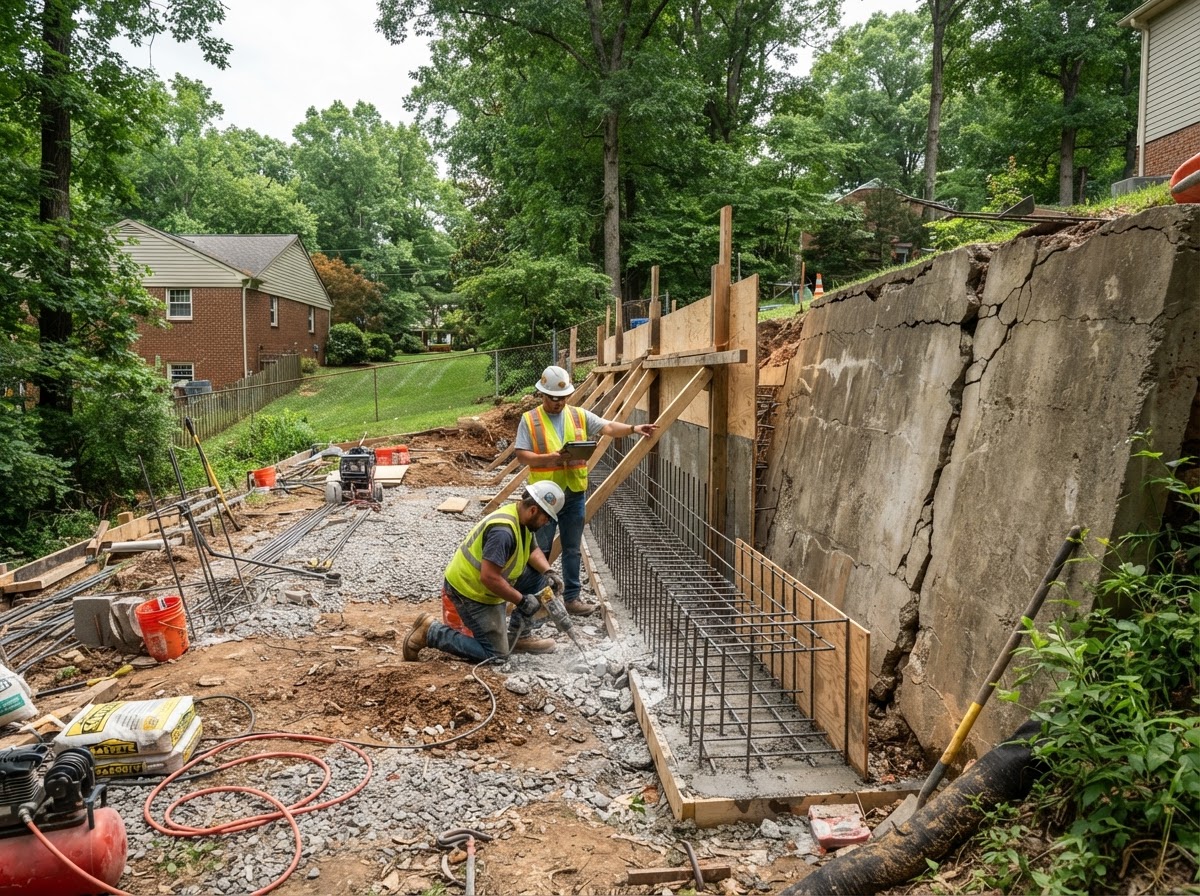
Concrete retaining wall repair and replacement address the cracks, leaning, bulging, and deterioration that develop when a wall can no longer hold back the soil and water behind it. Gaithersburg Concrete evaluates damaged retaining walls across Gaithersburg, Maryland and surrounding communities, then recommends a scope based on the cause and stability of the wall — because the right fix depends on whether the wall is still moving, whether drainage has failed, and how far the deterioration has spread. This page focuses on repair and replacement of existing retaining walls, while our broader retaining walls and concrete masonry page covers new wall installation. The appropriate repair depends on the cause and stability of the wall, and we do not diagnose structural safety remotely.
Request a Free Estimate
Tell us about your concrete project in Gaithersburg or nearby.
Concrete Retaining Wall Repair in Gaithersburg
A retaining wall holds back soil and supports a change in grade, and when it begins to fail the signs show up on the wall itself — cracks, leaning, bulging, broken sections, and deteriorated surfaces. In Gaithersburg, where many properties use retaining walls to terrace sloped terrain or create level yard space, wall damage is common as walls age, drainage fails, and freeze-thaw cycles add pressure season after season.
Retaining wall repair addresses the specific damage a wall has developed, while replacement removes a wall that has failed and rebuilds it. The two are not interchangeable: a wall with one isolated crack and stable structure may need only a targeted repair, while a wall that is leaning, draining poorly, and deteriorating throughout may need to come out and be rebuilt.
The appropriate repair depends on the cause and stability of the wall. A crack caused by drainage pressure behind the wall will not stay fixed if the drainage is not addressed, and a wall that is still moving will continue to move after a surface patch. We evaluate the cause and the stability before recommending a scope, and we do not diagnose structural safety remotely.
Signs a Retaining Wall May Need Repair or Replacement
Retaining walls show damage in recognizable ways. Some signs are cosmetic — surface spalling or a hairline crack — while others indicate movement or drainage failure that a surface repair alone will not solve.
Common Signs of Wall Distress
- Horizontal or vertical cracking across the wall face or joints
- Leaning or tilting where the wall has shifted from plumb
- Bulging or bowing where a section is pushing outward
- Water staining or seepage indicating drainage pressure behind the wall
- Erosion of soil at the base or behind the wall
- Failed drainage — blocked or broken weep paths
- Spalling and surface deterioration on the wall face
- Exposed reinforcement where concrete has broken away from steel
- Settlement where the wall or adjacent grade has dropped
- Displaced wall sections that have shifted out of alignment
Cosmetic deterioration and movement-related problems are different concerns. Surface spalling on a stable wall may be repairable, while leaning, bulging, or displaced sections point to pressure or drainage failure that a patch will not correct. We distinguish between the two before recommending a repair or a replacement.
How Retaining Wall Repairs Are Evaluated
A retaining wall repair starts with an assessment, not a fix. Understanding why the wall is failing determines what will actually hold — and what will not.
- 1Visual assessment — inspect the wall for cracks, lean, bulging, and deterioration.
- 2Movement — determine whether the wall appears stable or is still shifting.
- 3Wall height — note the wall dimensions and the load it carries.
- 4Drainage — check whether drainage behind the wall is functioning or failed.
- 5Backfill — assess the material behind the wall and its condition.
- 6Base condition — evaluate the base the wall rests on.
- 7Surrounding grade — review the slope and soil above and below the wall.
- 8Water pressure — identify whether hydrostatic pressure is loading the wall.
- 9Damaged sections — locate the specific areas of failure.
- 10Repair feasibility — determine whether a repair will hold or replacement is needed.
Depending on what the assessment finds, repair approaches may include crack repair, patching deteriorated areas, drainage corrections, localized replacement of a failed section, rebuilding damaged sections, or complete replacement of the wall. We do not promise one repair method before inspection — the scope follows the cause.
Drainage, Soil Pressure & Wall Stability
Water behind a retaining wall is the most common reason walls fail. Soil absorbs water, and that water exerts hydrostatic pressure against the wall. Without drainage to relieve that pressure — through weep holes, drainage aggregate, or a drainage system — the wall must hold back both the earth and the water, which is far more load than it was designed to carry.
Stability Factors
- Water behind the wall and the hydrostatic pressure it creates
- Drainage paths and whether they are clear or failed
- Backfill material and how it was placed and compacted
- Erosion of soil at or behind the wall base
- Base support the wall rests on
- Wall geometry — height, length, and thickness
- Grade changes above and below the wall
We do not provide structural engineering calculations. Where a wall has moved significantly, where drainage has failed broadly, or where the wall is tall or carries substantial load, project-specific engineering, approvals, or permits may be required. We coordinate around those requirements rather than proceeding on assumptions about what a wall can support.
For new wall installation rather than repair, see our retaining walls and concrete masonry page. For broad concrete repair, our concrete repair and crack repair services cover general damage; wall removal is handled through concrete demolition, and structural support under rebuilt walls draws on our concrete footings and addition foundations work. For damaged vertical concrete surfaces specifically, see our vertical concrete wall repair page.
Repair vs. Replacement for Retaining Walls
Repair may be appropriate for localized deterioration or isolated defects where the wall remains stable — a single crack, one spalled area, or a failed drainage path on an otherwise sound wall. In those cases, targeted repair extends the wall's life without the cost and disruption of a full rebuild.
Replacement may be more appropriate for significant movement, widespread deterioration, major drainage failure, or failed structural sections. A wall that is leaning, bulging across its length, or deteriorating throughout is not a candidate for surface repair — the pressure or drainage problem that caused the damage will continue to load the wall, and a patch will not hold.
Maryland freeze-thaw cycles and water exposure accelerate the failure. Moisture in the soil behind a wall expands as it freezes, increasing pressure, and poor drainage that lets water accumulate speeds the stress on the structure. Larger or structurally significant retaining walls may require project-specific engineering, approvals, or permits — we do not invent thresholds, and where those requirements apply we coordinate accordingly rather than proceeding on assumptions.
Discuss Your Concrete Project
Have questions about scope, timing, or whether repair or replacement is the right call? We are happy to review your project and provide a clear, honest estimate.
Retaining Wall Repair FAQs & Evaluations
Can a cracked retaining wall be repaired?
Some cracked concrete retaining walls can be repaired when the wall remains stable and the damage is localized, but movement, leaning, drainage pressure, or widespread deterioration may make partial or full replacement more appropriate. The right approach depends on the cause and stability of the wall, which we assess before recommending a scope.
Why is my retaining wall leaning?
A retaining wall leans most often because of water pressure behind the wall, failed drainage, an inadequate base, or erosion of the soil that supports it. Water-saturated soil exerts pressure the wall was not designed to hold, and freeze-thaw cycles add to that load. A leaning wall is a movement sign, not just a cosmetic issue.
Can drainage cause retaining wall failure?
Yes. Without drainage to relieve water pressure behind the wall, the wall must hold back both the soil and the accumulated water, which is far more load than the earth alone. Failed or blocked drainage is one of the most common reasons retaining walls lean, bulge, or fail.
When should a retaining wall be replaced?
Replacement is typically the better choice when the wall has significant movement, widespread deterioration, major drainage failure, or failed structural sections. When damage spans most of the wall or the cause is still active, a series of patches rarely holds as well as a rebuild. We assess the condition before recommending repair or replacement.
Can only part of a retaining wall be rebuilt?
In some cases a single failed section can be removed and rebuilt while the rest of the wall remains, provided the surrounding wall is stable and the connection is detailed correctly. Where damage is widespread or the wall has moved broadly, full replacement often produces a more stable result. We evaluate whether a partial rebuild is feasible before recommending it.
Does retaining wall repair require engineering?
Larger or structurally significant retaining walls may require project-specific engineering, approvals, or permits based on the wall height, load, and applicable requirements. We do not invent thresholds or give definitive code limits without verified local requirements — where engineering or permits apply, we coordinate around them rather than proceeding on assumptions.
What affects retaining wall repair cost?
Cost depends on the wall height and length, the extent of damage, whether drainage correction is needed, whether a section is rebuilt or the whole wall replaced, excavation and backfill, site access, and any engineering or permit coordination. A localized repair costs less than a full rebuild. We provide project-specific estimates based on the actual wall and condition.
Request a Retaining Wall Evaluation
If a retaining wall on your Gaithersburg property is cracking, leaning, or deteriorating, Gaithersburg Concrete will assess the cause and stability, then recommend a repair or replacement scope and provide a clear estimate. Serving Gaithersburg and surrounding Montgomery County communities.
Related Concrete Services Near Gaithersburg
Retaining Walls & Concrete Masonry
Poured concrete and structural masonry retaining walls built to prevent soil erosion and terrace uneven Maryland topography.
Learn moreConcrete Repair & Crack Repair
Targeted structural crack filling, spalling remediation, and damaged section patching to extend concrete longevity.
Learn moreConcrete Demolition, Removal & Replacement
Concrete demolition, removal, haul-away, and replacement for driveways, patios, walkways, and slabs.
Learn moreConcrete Footings & Addition Foundations
Concrete footings and foundation concrete for home additions, porches, and small structures.
Learn moreVertical Concrete Wall Repair
Repair of vertical concrete surfaces including cracks, spalling, honeycombing, broken corners, and surface deterioration on walls and vertical concrete.
Learn moreRequest a Retaining Wall Evaluation
If a retaining wall on your Gaithersburg property is cracking, leaning, or deteriorating, Gaithersburg Concrete will assess the cause and stability, then recommend a repair or replacement scope and provide a clear estimate. Serving Gaithersburg and surrounding Montgomery County communities.
- Project-specific estimates — no obligation
- Residential and commercial concrete work
- Serving Gaithersburg and surrounding Montgomery County
Request a Free Estimate
Tell us about your concrete project in Gaithersburg or nearby.