Concrete Thickness, Base & Reinforcement Guide
Concrete thickness depends on intended use, expected loads, slab dimensions, base conditions, reinforcement, project design, and applicable requirements. A residential patio, driveway, equipment pad, and industrial slab should not automatically be designed the same way. This guide from Gaithersburg Concrete explains why thickness, base preparation, and reinforcement vary for concrete slabs in Gaithersburg, Maryland — without publishing one universal thickness, inventing code requirements, or claiming every slab needs rebar. The goal is to help homeowners and property managers understand the variables that drive slab planning so they can ask the right questions and move to the right service — whether that is a patio, driveway, garage floor, equipment pad, or industrial foundation.
Request a Free Estimate
Tell us about your concrete project in Gaithersburg or nearby.
How Thick Should Concrete Be?
Concrete thickness depends on intended use, expected loads, slab dimensions, base conditions, reinforcement, project design, and applicable requirements. A residential patio, driveway, equipment pad, and industrial slab should not automatically be designed the same way — each carries different loads and sits on different support, so the slab that suits one is not automatically right for another.
Thickness Depends On
- Intended use — pedestrian, vehicle, or equipment
- Vehicle or equipment loads the slab will carry
- Soil and base support beneath the slab
- Slab size and dimensions
- Reinforcement included in the design
- Edges and how the slab is supported at the perimeter
- Manufacturer requirements for equipment the slab supports
- Project plans, engineering, and applicable requirements
There is no single correct thickness for every concrete slab. A patio used for foot traffic and furniture has different demands than a driveway that carries vehicles, a hot tub pad that carries concentrated weight, an RV pad, or a commercial slab that handles delivery trucks. The right thickness follows the use, the loads, the base, and the project requirements — not a one-size-fits-all rule.
Why Concrete Thickness Matters
Thickness matters because it is how a slab distributes loads down into the base beneath it. A thicker slab spreads concentrated weight over a wider area of support, which reduces the stress that reaches any one point and lowers the risk of cracking under load.
What Thickness Affects
- Load distribution — how weight spreads into the base
- Cracking risk under concentrated or repetitive loads
- Edge strength — how the perimeter holds up to wheel or equipment loads
- Resistance to concentrated loads from equipment or vehicles
- Overall structural performance over time
Why Different Uses Need Different Thickness
- Patio — primarily pedestrian and furniture loads
- Walkway — foot traffic and light use
- Driveway — vehicle loads and repetitive traffic
- Garage floor — vehicle loads plus enclosed, supported edges
- Shed pad — light structure and storage loads
- Hot tub pad — concentrated water and tub weight
- RV pad — heavy vehicle and point loads
- Commercial slab — repetitive vehicle and equipment traffic
- Machine foundation — concentrated static and dynamic equipment loads
Each of those uses places a different demand on the slab. A thickness that is adequate for a patio may be inadequate for a driveway; a thickness that suits a driveway may be inadequate for an RV pad or a piece of equipment. That is why thickness is matched to the use rather than applied uniformly.
Why Base Preparation Matters
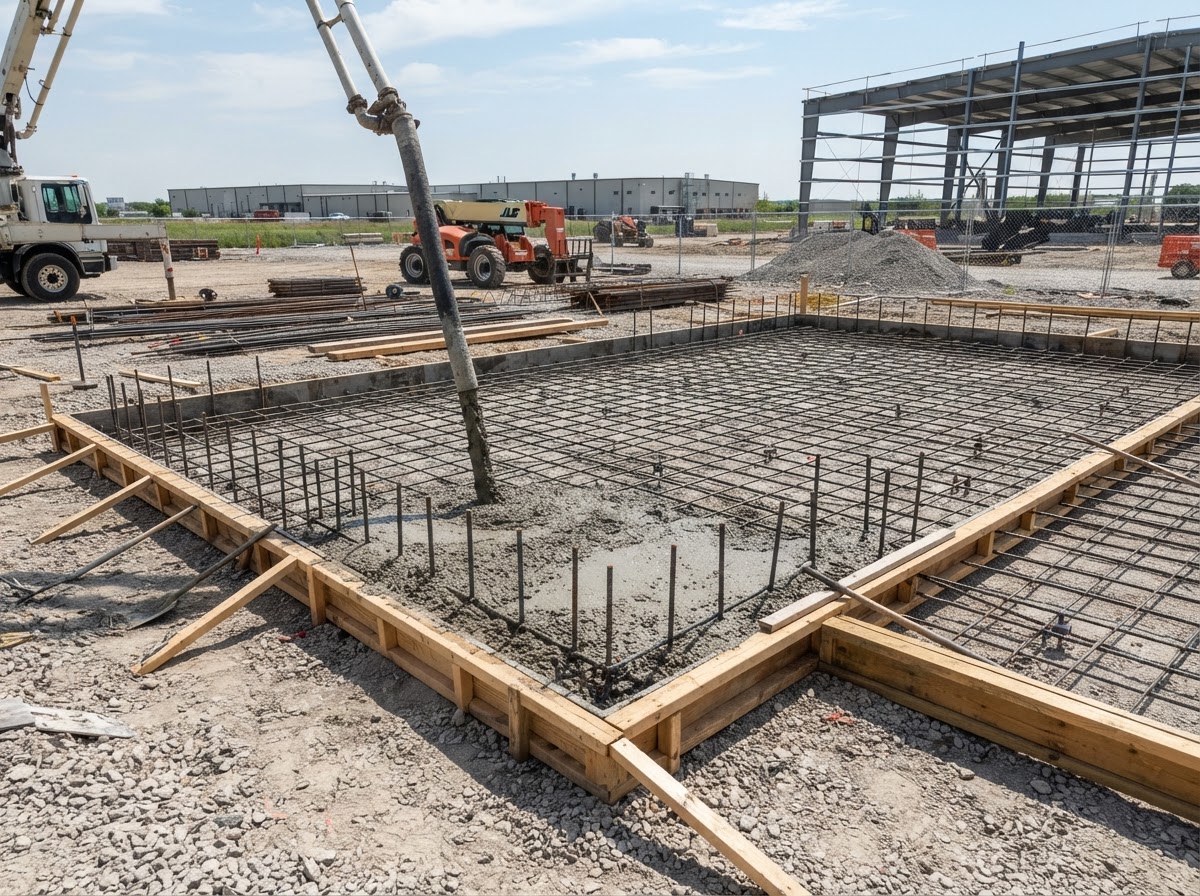
The base beneath a concrete slab is what the slab rests on, and it does much of the structural work. Even a correctly placed, correctly thick slab can crack or settle when the support beneath it is inadequate, uneven, or affected by water movement. Base preparation — excavation, subgrade, compaction, and an aggregate base — is what gives the slab uniform, stable support.
What Base Preparation Involves
- Excavation to the right depth for the slab and base
- Subgrade preparation — the native soil the base sits on
- Compaction of the subgrade and base material
- Aggregate base — a prepared layer of stone beneath the slab
- Drainage planning so water does not undermine the base
- Uniform support across the slab area
- Removing soft spots, organic material, or unstable soil
What Poor Base Preparation Causes
- Erosion — water washing material out from under the slab
- Voids — empty space beneath the slab where support is missing
- Settlement — the slab sinking as the base compacts or shifts
- Cracking — stress concentrations where support is uneven
Can Good Concrete Fail on a Poor Base?
Yes. Even properly placed concrete can crack or settle when support beneath the slab is inadequate, uneven, or affected by water movement. A slab is only as reliable as the base it rests on — which is why base preparation is part of the scope, not an afterthought, and why drainage and compaction matter as much as the concrete itself.
Does Concrete Need Reinforcement?
Reinforcement is not universal — not every slab requires it, and not every slab requires the same kind. Whether reinforcement is appropriate, and what kind, depends on the slab's use, loads, dimensions, and project requirements. Reinforcement helps manage cracking and distribute loads, but it does not prevent all cracking.
Common Reinforcement Concepts
- Reinforcing steel — rebar placed within the slab
- Welded wire reinforcement — a grid of wire within the slab
- Fibers — added to the mix to help control shrinkage cracking
- Dowels — to load-transfer across joints or connect adjacent pours
- Project-specific reinforcement per plans or specifications
What Reinforcement Does
- Crack control — helping manage where and how cracks spread
- Load distribution — spreading concentrated loads across the slab
- Slab continuity — holding sections together across joints
- Edge and connection support depending on the design
Reinforcement does not prevent all cracking. Concrete cracks as it shrinks during curing and as it moves with the base and temperature; reinforcement helps control those cracks rather than eliminate them. That is why joint placement — control joints that create planned crack locations — is used alongside reinforcement, and why not every slab is designed the same way.
Whether a specific project needs reinforcement, and what type, should follow applicable plans, specifications, and project requirements rather than a universal rule.
Thickness, Base & Reinforcement in Maryland Conditions
Maryland conditions affect thickness, base, and reinforcement planning because they affect both the concrete and what lies beneath it. Freeze-thaw cycles, water, saturated soils, erosion, and deicing exposure all stress a slab and its base — which is why drainage and support can be as important as concrete thickness.
- Freeze-thaw cycles stress the surface and the base beneath it
- Water and saturated soils weaken base support
- Base drainage prevents water from undermining the slab
- Erosion washes base material out from under the slab
- Deicing exposure accelerates surface scaling
- Temperature movement stresses joints and the slab
- Joint planning manages seasonal expansion and contraction
The key point: proper drainage and base support can be as important as concrete thickness. A slab of the right thickness can still fail on a wet, eroding, or poorly compacted base — which is why base preparation, drainage, and reinforcement are planned together with thickness rather than treated as separate concerns.
Questions to Ask Before a Concrete Slab Is Poured
Ask These Questions
- What will the slab support — people, vehicles, or equipment?
- Will vehicles use it, and what kind?
- Is equipment involved, and is manufacturer guidance available?
- What is the base condition beneath the slab?
- Is reinforcement required by the project or design?
- How will water drain off and away from the slab?
- Where will control joints be placed?
- Are there existing slabs to connect to or match?
- Are project plans, engineering, or permits involved?
For the services this guide supports, see our concrete slabs, pads and foundations, driveways, garage floors, parking and RV pads, equipment pads, and industrial equipment foundations pages. For the cost side, see our concrete cost guide and driveway cost guide.
Discuss Your Concrete Project
Have questions about scope, timing, or whether repair or replacement is the right call? We are happy to review your project and provide a clear, honest estimate.
Concrete Thickness & Reinforcement FAQs & Estimates
How thick should a concrete driveway be?
Driveway thickness depends on vehicle loads, base support, slab dimensions, reinforcement, and applicable requirements. A driveway that carries passenger vehicles has different demands than one that carries heavier trucks or an RV. There is no single universal driveway thickness — the right value follows the use, the base, and the project requirements rather than a one-size-fits-all rule.
How thick should a concrete patio be?
Patio thickness depends on intended use, base support, slab size, and whether the patio will carry concentrated loads like a hot tub. A patio used for foot traffic and furniture has different demands than one supporting heavy features. Project-specific requirements vary, so patio thickness should follow the use and base conditions rather than a universal number.
Does concrete need gravel underneath?
A prepared aggregate base is common beneath concrete slabs because it provides uniform, well-drained support for the slab. Whether a base is needed and how it is built depends on the slab's use, the subgrade, drainage, and project requirements. Base preparation — compaction, aggregate, and drainage — is part of giving the slab stable support.
Does concrete always need rebar?
No. Not every slab requires reinforcement, and not every slab requires the same kind. Whether reinforcement is appropriate depends on the slab's use, loads, dimensions, and project requirements. Reinforcement helps control cracking and distribute loads, but it does not prevent all cracking, and it is not universal — it should follow applicable plans and specifications.
What happens if concrete is too thin?
A slab that is too thin for its use is more likely to crack under load, particularly under concentrated or repetitive loads like vehicles or equipment. Thin slabs distribute less load into the base, so stress concentrates and cracking risk rises. The right thickness is matched to the use and base rather than applied uniformly.
Can thicker concrete prevent cracking?
Thicker concrete can reduce cracking risk under load by spreading weight over a wider area of base, but it does not prevent all cracking. Concrete cracks as it shrinks during curing and moves with the base and temperature. Thickness, joint placement, reinforcement, base preparation, and drainage all work together to manage cracking — thickness alone is not a guarantee.
Why does base preparation matter?
The base is what the slab rests on, and it does much of the structural work. Even a correctly placed slab can crack or settle on an inadequate, uneven, or water-affected base. Excavation, compaction, aggregate base, and drainage give the slab uniform, stable support — which is why base preparation is part of the scope, not an afterthought.
Who determines slab thickness for heavy equipment?
For equipment that imposes concentrated or dynamic loads, slab thickness and reinforcement should follow the equipment loads, manufacturer specifications, project plans, and any structural requirements. Project-specific engineering or approved structural plans may determine final dimensions, reinforcement, and concrete specifications. We do not invent those values — we build to the requirements that apply to the project.
Discuss Your Concrete Slab Requirements
Planning a concrete slab in Gaithersburg or surrounding Montgomery County? Gaithersburg Concrete will review the intended use, loads, base conditions, drainage, and reinforcement needs and recommend the right scope. Call (240) 690-6035 or request a free estimate.
Keep Learning About Concrete in Gaithersburg
Concrete Cost Guide for Gaithersburg, MD
What affects concrete project costs in Gaithersburg — size, demolition, access, base, thickness, reinforcement, finish, grading and drainage.
Read the guideConcrete Driveway Cost Guide for Gaithersburg, MD
What changes concrete driveway cost in Gaithersburg — dimensions, removal, base, thickness, reinforcement, drainage and finish.
Read the guideRelated Concrete Services Near Gaithersburg
Concrete Slabs, Pads & Foundations
Heavy-duty concrete pads for backyard sheds, hot tubs, HVAC units, backup generators, and residential accessory structures.
Learn moreConcrete Driveway Installation & Replacement
Durable residential and light commercial concrete driveways built to withstand vehicular weight and Maryland freeze-thaw cycles.
Learn moreConcrete Garage Floors & Garage Slabs
New garage slab pours and replacement garage floors built for vehicle loads, storage, and workshop use.
Learn moreConcrete Parking Pads & RV Pads
Concrete parking pads and RV pads built for vehicle, trailer, and camper loads with proper base, reinforcement, and drainage.
Learn moreConcrete Generator Pads & Equipment Pads
Concrete generator and equipment pads for standby generators, HVAC units, and mechanical equipment.
Learn moreIndustrial Equipment Foundations & Machine Pads
Concrete equipment foundations and machine pads built to equipment loads, anchoring, vibration, and manufacturer specifications for industrial facilities.
Learn moreDiscuss Your Concrete Slab Requirements
Planning a concrete slab in Gaithersburg or surrounding Montgomery County? Gaithersburg Concrete will review the intended use, loads, base conditions, drainage, and reinforcement needs and recommend the right scope. Call (240) 690-6035 or request a free estimate.
- Project-specific estimates — no obligation
- Residential and commercial concrete work
- Serving Gaithersburg and surrounding Montgomery County
Request a Free Estimate
Tell us about your concrete project in Gaithersburg or nearby.