Concrete Trench Drains & Drainage Channels in Gaithersburg, MD
A concrete trench drain or drainage channel intercepts surface water across a paved area and directs it toward an appropriate discharge point, keeping driveways, patios, and flatwork from pooling, flooding, or deteriorating under standing water. Gaithersburg Concrete installs trench and channel drains integrated into concrete flatwork across Gaithersburg, Maryland and surrounding communities, planning the drain alignment, the low point, and the outlet before any concrete is cut or poured. This page focuses on concrete-integrated surface drainage — the drains set into driveways, patios, and flatwork — rather than comprehensive civil engineering or municipal stormwater design. Where a drainage problem is part of a larger site or stormwater system, we coordinate around those requirements rather than claiming capabilities beyond the concrete work itself.
Request a Free Estimate
Tell us about your concrete project in Gaithersburg or nearby.
Concrete Trench Drains in Gaithersburg
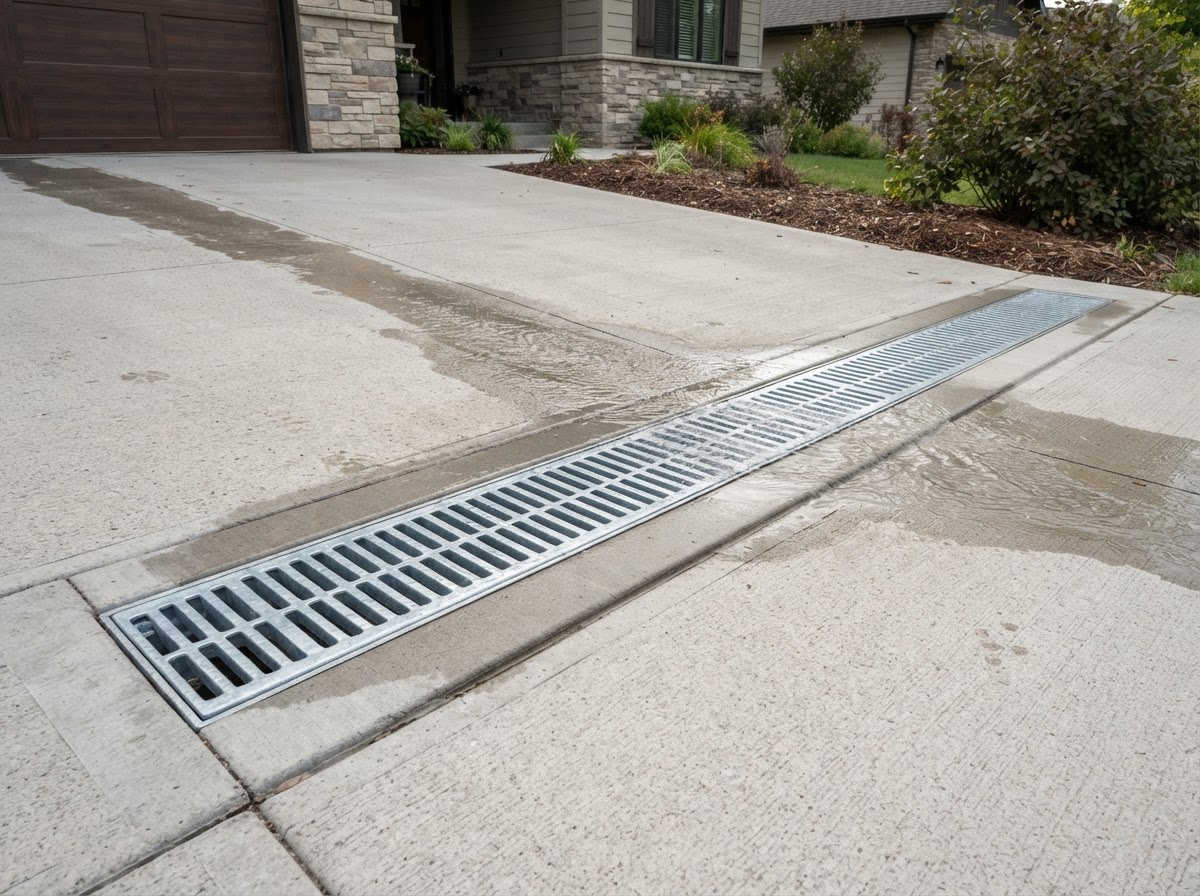
A trench drain — also called a channel drain — is a linear drainage structure set into a paved surface to intercept sheet flow across the concrete and carry it to an outlet. Installed across a driveway, along a patio edge, or through a commercial apron, a trench drain catches water before it pools, runs toward a garage, or crosses a walkway it should not.
In Gaithersburg, where sloped driveways, flat patios, and tight lot grading all create drainage challenges, a trench drain integrated into the concrete is often the cleanest way to move surface water off a paved area. The drain sits flush with the concrete, the grate catches the water, and the channel carries it to a discharge point — keeping the surface above it dry and usable.
This page focuses on concrete-integrated surface drainage: the drains set into driveways, patios, garage entrances, commercial flatwork, loading areas, walkways, and sloped hardscape. We do not claim to provide comprehensive civil engineering or municipal stormwater design. Where a drainage problem is part of a larger site or stormwater system, we coordinate around those requirements rather than assuming one drain solves every problem.
Signs a Concrete Surface May Need Better Drainage
Drainage problems on concrete surfaces show up as water behavior — where it pools, where it runs, and where it sits after rain. Recognizing the pattern helps determine whether a trench drain is the right fix.
Common Drainage Signs
- Water pooling on a driveway, patio, or walkway after rain
- Runoff flowing toward a garage or building entrance
- Water crossing a walkway or path where it should not
- Puddling on a patio that does not shed water
- Erosion of soil or mulch beside the concrete edge
- Repeated icing across a surface in winter
- Water collecting at low points where the grade traps it
- Runoff from a sloped driveway sheeting across the pavement
We do not claim a trench drain is always the correct solution. Some drainage problems are better addressed by regrading the surface, adjusting the slope, or correcting a downspout discharge. A trench drain is the right fix when the goal is to intercept sheet flow across a paved area at a low point or a transition — and we assess whether that is the case before recommending one.
How a Trench Drain Is Installed in Concrete
Installing a trench drain in existing or new concrete follows a sequence built around the low point, the outlet, and the integration with the surrounding surface.
- 1Drainage assessment — evaluate where water collects and where it should go.
- 2Determining the low point — locate where the drain will intercept flow.
- 3Planning drain alignment — lay out the channel across the surface.
- 4Cutting and removing existing concrete where applicable — saw-cut and remove the slab section for the drain.
- 5Excavation — dig the trench for the drain body and outlet.
- 6Base preparation — add and compact base material under the drain.
- 7Drain body and channel placement — set the channel to the correct elevation and slope.
- 8Outlet coordination — connect the channel to the discharge point.
- 9Concrete placement around the channel — pour and finish the concrete flush with the grate.
- 10Grading — set the surrounding slope so water reaches the drain.
- 11Curing — allow the concrete to gain strength before the area returns to use.
We do not claim plumbing or underground drainage work beyond the actual scope. Where a drain ties into a storm system, a dry well, or an underground pipe, that connection is coordinated with the project requirements — we focus on the concrete-integrated drain and the surface around it.
Drain Width, Load Rating, Grates & Slope Considerations
A trench drain has to be sized and rated for the water it will carry and the traffic it will see. A drain under a passenger vehicle driveway, a pedestrian patio, and a commercial loading area each need different capacity, grate strength, and slope.
Design Factors
- Water volume the drain needs to carry
- Surface slope directing water toward the channel
- Vehicle traffic — passenger cars versus heavier loads
- Pedestrian traffic and grate safety for foot traffic
- Grate type suited to the traffic and debris load
- Channel capacity matched to the drainage area
- Outlet location and where the water discharges
- Driveway loads the drain and grate must support
- Maintenance access for cleaning the channel
We avoid product-specific claims unless specified for the project. The drain width, grate rating, and slope are chosen based on the site conditions and the traffic the drain will see — a drain that is too narrow or too lightly rated for its location will clog, fail, or break under load.
For the surfaces a trench drain is set into, see our concrete driveway and concrete patio pages; for commercial flatwork, our commercial concrete and flatwork services. Existing concrete that must be removed for a drain is handled through concrete demolition, and damaged concrete around a drain is addressed in our concrete repair services. For driveway-specific water problems — standing water, low spots, and runoff — see our concrete driveway drainage repair page.
Concrete Drainage Problems in Maryland
Drainage on concrete surfaces in Gaithersburg is shaped by heavy rain, freeze-thaw cycles, snow melt, and ice formation through the winter. Water that pools on a surface or runs beneath a slab contributes to erosion, saturation, and freeze-thaw deterioration, and a drain that is clogged or poorly placed does not move that water off the surface the way it should.
Water beneath slabs is a particular concern. Runoff that finds its way under a driveway or patio erodes the base, and a slab that loses its base settles and cracks. A trench drain that intercepts surface flow before it reaches the slab edge helps protect the base as well as the surface, and joint deterioration and settlement are often signs that drainage has been failing for some time.
Can Drainage Problems Damage Concrete?
Yes. Repeated water movement across or beneath a concrete surface can contribute to erosion, saturation, freeze-thaw deterioration, and settlement depending on the site conditions. Water that pools on a surface scales and spalls the concrete over freeze-thaw cycles, and water that runs beneath a slab erodes the base the slab rests on. Drainage is not just a convenience issue — it is a factor in how long the concrete lasts.
Discuss Your Concrete Project
Have questions about scope, timing, or whether repair or replacement is the right call? We are happy to review your project and provide a clear, honest estimate.
Concrete Trench Drain FAQs & Estimates
What is a concrete trench drain?
A concrete trench drain — also called a channel drain — is a linear drainage structure set into a paved surface to intercept sheet flow across the concrete and carry it to an outlet. Installed across a driveway, along a patio edge, or through a commercial apron, it catches water before it pools or runs where it should not.
Can a trench drain be added to an existing driveway?
Yes. A trench drain can be cut into an existing concrete driveway by saw-cutting the slab, excavating the trench, setting the drain body, and pouring new concrete flush with the grate. The drain is placed at the low point where water collects so it intercepts the flow before it pools.
Can trench drains help stop water from entering a garage?
A trench drain across the driveway approach at the garage can intercept runoff before it reaches the garage entrance, which is a common use for driveway drainage channels. Whether it fully solves a garage water problem depends on the slope, the water volume, and the outlet — we assess the conditions before recommending a drain.
Where does trench-drain water go?
Trench-drain water is directed to an appropriate discharge point — a storm connection, a dry well, a daylight outlet, or another approved destination depending on the site and applicable requirements. The outlet is coordinated with the project rather than assumed. We do not claim to provide municipal stormwater design beyond the concrete-integrated drain itself.
Can vehicles drive over a trench drain?
Yes, when the drain and grate are rated for the traffic load. Trench drains are available with grates rated for pedestrian, passenger-vehicle, or heavier loads, and the grate and channel are chosen based on what will cross them. A drain under a driveway uses a heavier-duty grate than one under a patio.
Can a patio have a drainage channel?
Yes. A drainage channel can be installed across or along a patio to intercept water that would otherwise pool on the surface, set flush with the patio finish so it integrates cleanly. The drain is placed at the low point where water collects, with the slope graded so water reaches the channel.
What affects trench-drain installation cost?
Cost depends on the drain length and width, whether existing concrete must be cut and removed, excavation and base work, the grate rating, the outlet connection, the surrounding concrete finish, and site access. A longer drain cut into existing concrete costs more than a short drain in a new pour. We provide project-specific estimates based on the actual site.
Request a Concrete Drainage Evaluation
If water is pooling on your driveway, patio, or flatwork in Gaithersburg, Gaithersburg Concrete will assess the drainage, plan the trench or channel drain, and provide a clear estimate for the installation. Serving Gaithersburg and surrounding Montgomery County communities.
Related Concrete Services Near Gaithersburg
Concrete Driveway Installation & Replacement
Durable residential and light commercial concrete driveways built to withstand vehicular weight and Maryland freeze-thaw cycles.
Learn moreConcrete Patio Installation & Replacement
Custom concrete backyard patios engineered for outdoor living, cookouts, and year-round family entertainment.
Learn moreCommercial Concrete & Concrete Flatwork
High-spec flatwork for commercial centers, retail plazas, loading docks, dumpster pads, and multi-family communities.
Learn moreConcrete Demolition, Removal & Replacement
Concrete demolition, removal, haul-away, and replacement for driveways, patios, walkways, and slabs.
Learn moreConcrete Repair & Crack Repair
Targeted structural crack filling, spalling remediation, and damaged section patching to extend concrete longevity.
Learn moreRequest a Concrete Drainage Evaluation
If water is pooling on your driveway, patio, or flatwork in Gaithersburg, Gaithersburg Concrete will assess the drainage, plan the trench or channel drain, and provide a clear estimate for the installation. Serving Gaithersburg and surrounding Montgomery County communities.
- Project-specific estimates — no obligation
- Residential and commercial concrete work
- Serving Gaithersburg and surrounding Montgomery County
Request a Free Estimate
Tell us about your concrete project in Gaithersburg or nearby.