Grind & Seal Concrete Floors in Gaithersburg, MD
Grind and seal is a concrete-floor finishing process in which the surface is mechanically ground to remove irregularities and expose the desired amount of concrete or aggregate, then protected with an appropriate sealer or coating. Gaithersburg Concrete finishes grind and seal floors for basements, workshops, garages where compatible, utility rooms, and suitable commercial spaces across Gaithersburg, Maryland and surrounding communities. Grind and seal differs from polishing: it pairs mechanical preparation with an applied protective finish rather than refining the concrete itself to a final surface. Every project starts with a floor condition review to confirm the slab is suitable and to choose a sealer compatible with the surface, the moisture conditions, and how the floor will be used.
Request a Free Estimate
Tell us about your concrete project in Gaithersburg or nearby.
What Is a Grind & Seal Concrete Floor?
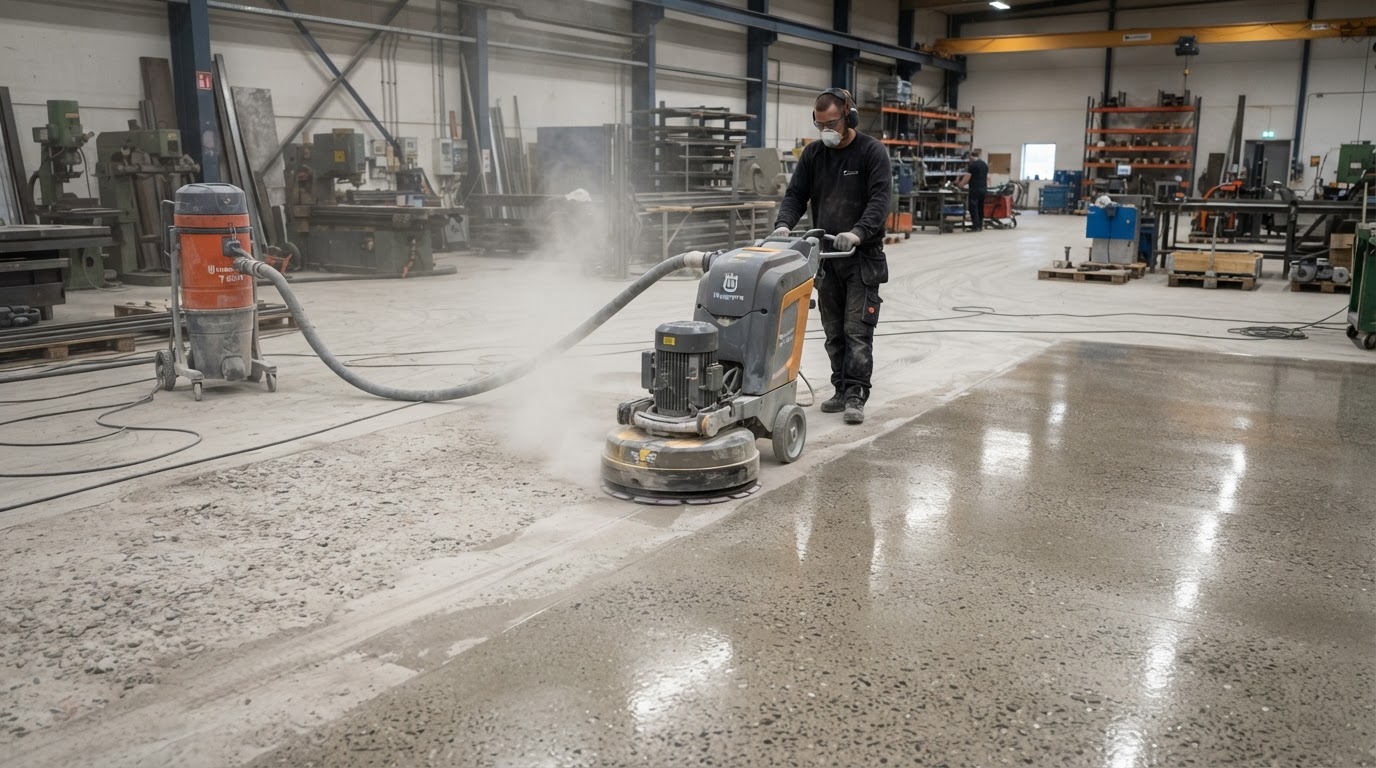
Grind and seal is a flooring process that mechanically prepares and refines a concrete surface, then applies a compatible sealer or protective finish over the prepared floor. The grinding removes minor surface irregularities, old coatings, or adhesives and exposes the amount of concrete or aggregate desired, and the sealer protects the prepared surface and sets the sheen.
This differs from polished concrete in an important way. Polishing mechanically refines the concrete to a final surface through progressively finer abrasives. Grind and seal stops at mechanical preparation and relies on an applied sealer or topcoat for protection and appearance. The two finishes can look similar, but the process and the maintenance differ.
Grind and seal is often considered for basements, workshops, garages where the system is compatible, utility rooms, commercial spaces, warehouse support areas, retail and service spaces, and older concrete floors where a full mechanical polish is not the right fit. We do not claim it is universally cheaper than polishing — the right choice depends on the slab, the use, and the desired look.
Where Grind & Seal Floors Are Used
Grind and seal works well on interior slabs that benefit from mechanical preparation and a protective finish but do not require a full mechanical polish. Suitable applications include basements, workshops, garages where the sealer is compatible with vehicle use, utility rooms, commercial spaces, warehouse support areas, retail and service spaces, and older concrete floors that need surface renewal.
Why Grind & Seal Is Chosen
- Exposes the concrete's natural character and aggregate where desired
- Can remove some old surface materials, coatings, or adhesives during preparation
- Creates a uniform, prepared appearance before the sealer is applied
- Allows different sheen options depending on the selected sealer system
- Can be simpler than full mechanical polishing for certain floors and conditions
- Pairs mechanical preparation with a protective layer suited to the floor's use
The final appearance depends heavily on the existing slab. A floor with consistent concrete and minimal patching finishes more uniformly than one with extensive repairs, stains, or contamination. We review the floor before recommending grind and seal and set expectations for what the finished surface will look like.
Grind & Seal Floor Preparation Process
A grind and seal floor follows a preparation and finishing sequence built around the slab's condition and the selected sealer.
- 1Floor condition review — assess the slab, existing coatings, adhesives, cracks, and moisture.
- 2Coating and adhesive review — identify old sealers, paint, or glue that must be removed.
- 3Mechanical grinding — prepare the surface and expose the desired amount of concrete or aggregate.
- 4Edge work — refine the perimeter and tight areas the main grinding cannot reach.
- 5Crack and patch assessment — review how existing cracks and patches will appear under the sealer.
- 6Cleaning and dust removal — remove grinding dust and residue so the sealer bonds properly.
- 7Compatible sealer selection — choose a sealer suited to the surface, moisture, and floor use.
- 8Application — apply the sealer or protective finish over the prepared floor.
- 9Cure and dry requirements — allow the sealer to cure before the floor returns to use.
- 10Reopening for use — coordinate when the floor can handle traffic based on the system.
Moisture and contamination can affect sealer suitability. We do not claim all old coatings can be easily removed — some adhesives or sealers require more aggressive preparation, and a slab with persistent moisture may need a different approach before any sealer is applied.
Finish, Sheen & Sealer Considerations
The finished look of a grind and seal floor comes from two things: how the surface is ground and the sealer applied over it. The sheen, the aggregate exposure, and how the slab's history shows through all depend on these choices.
Finish Variables
- Matte, satin, or gloss sheen depending on the sealer system used
- Aggregate exposure from a cream surface to a heavier stone reveal
- Existing patch visibility, which the sealer does not hide
- Stains or discoloration in the concrete that remain part of the surface
- Concrete coloration from the cement and aggregate in the mix
- Traction considerations where the floor is walked or driven on
- Floor use — residential, commercial, or vehicle traffic — and the sealer's compatibility
- Maintenance and recoat requirements where applicable to the selected system
The final appearance depends heavily on the existing slab. A sealer protects and enhances the prepared surface; it does not create a uniform, flawless look where the concrete beneath is inconsistent. Where a more uniform or higher-performance surface is needed, a coating such as epoxy may be the better choice.
Grind & Seal vs. Other Floor Finishes
| Feature | Grind & Seal | Polished Concrete | Epoxy |
|---|---|---|---|
| Surface character | Ground concrete + applied sealer | Mechanically refined concrete | Resinous coating over concrete |
| Coating layer | Yes — sealer or topcoat | No coating layer | Yes — resin film |
| Preparation | Mechanical grinding | Progressive abrasive refinement | Mechanical surface prep |
| Sheen | Depends on sealer | Depends on refinement level | Depends on system |
| Repair visibility | Patches remain visible | Patches remain visible | Coating can mask some surface wear |
Existing Concrete, Moisture & Maintenance
A grind and seal system is only as dependable as the slab beneath it and the sealer's compatibility with the conditions. Slab moisture, cracks, joints, old coatings, adhesives, oil contamination, and surface repair all affect how the sealer performs and how long the finish lasts.
Condition Factors
- Slab moisture and vapor that can affect sealer adhesion or cause failure
- Cracks and joints that remain part of the surface under the sealer
- Old coatings or adhesives that must be fully removed for the sealer to bond
- Oil or chemical contamination that can interfere with the finish
- Surface repair and patching that shows through the sealer
- Cleaning practices suited to the selected sealer
- Recoat requirements where applicable to the system over time
A grind and seal system does not fix structural slab movement, active moisture problems, or serious settlement. Where those conditions exist, the underlying issue should be addressed first — a sealer over an unstable or wet slab will not perform. For related work, see our concrete repair and crack and joint repair pages, our interior concrete floors page, and our concrete sealing page. For the broader repair-versus-replacement decision, see our repair vs. replacement guide.
Discuss Your Concrete Project
Have questions about scope, timing, or whether repair or replacement is the right call? We are happy to review your project and provide a clear, honest estimate.
Grind & Seal Concrete FAQs & Estimates
What is grind and seal concrete?
Grind and seal is a floor-finishing process that mechanically grinds a concrete surface to remove irregularities and expose the desired concrete or aggregate, then applies a compatible sealer or protective finish over the prepared floor. It pairs mechanical preparation with an applied protective layer.
Is grind and seal the same as polished concrete?
No. Polished concrete mechanically refines the concrete itself through progressively finer abrasives to a final surface with no coating. Grind and seal stops at mechanical preparation and applies a sealer or topcoat for protection and sheen. The processes, appearance, and maintenance differ.
Can old concrete be ground and sealed?
Yes, some older concrete can be ground and sealed when the slab is structurally sound and the surface can be prepared. Old coatings, adhesives, oil contamination, and moisture all affect suitability. We review the floor's condition before recommending grind and seal.
Can basement floors be ground and sealed?
Some basement floors can be ground and sealed when the slab is suitable and moisture is manageable. Basement slabs often have moisture considerations that affect sealer choice, and we evaluate those conditions before recommending a finish.
Will grinding remove old coatings?
Mechanical grinding can remove many old coatings, sealers, and adhesives, but not all of them come off easily. Some materials require more aggressive preparation, and a slab with persistent contamination may need a different approach. We assess the existing surface before promising removal.
Can cracks still be visible after grind and seal?
Yes. Grinding and sealing refine and protect the surface, but existing cracks, patches, and the slab's repair history remain visible under the sealer. A grind and seal finish does not hide the concrete's history the way a thicker coating might.
What affects grind and seal floor cost?
Cost depends on the floor condition, existing coatings or adhesives that must be removed, the extent of grinding, crack and patch preparation, edge work, square footage, the selected sealer and sheen, and access. A floor that needs extensive preparation costs more than a clean, suitable slab. We provide project-specific estimates.
Request a Concrete Floor Evaluation
If you are considering a grind and seal finish for a basement, workshop, garage, or commercial floor, Gaithersburg Concrete will review the slab, confirm sealer compatibility, and provide a clear estimate. Serving Gaithersburg and surrounding Montgomery County communities.
Related Concrete Services Near Gaithersburg
Basement & Interior Concrete Floor Installation
Basement and interior concrete floor installation and replacement for utility and work spaces.
Learn moreConcrete Sealing & Waterproofing
Surface sealing and water-repellent treatments for driveways, patios, stamped concrete, and other suitable surfaces.
Learn morePolished Concrete Floors
Mechanically refined polished concrete floors for suitable commercial interiors, warehouses, and basements where the slab condition supports polishing.
Learn moreEpoxy Garage & Commercial Floor Coatings
Epoxy floor coatings applied over properly prepared concrete for suitable residential garages, workshops, and commercial floors, with preparation and repair planned first.
Learn moreRequest a Concrete Floor Evaluation
If you are considering a grind and seal finish for a basement, workshop, garage, or commercial floor, Gaithersburg Concrete will review the slab, confirm sealer compatibility, and provide a clear estimate. Serving Gaithersburg and surrounding Montgomery County communities.
- Project-specific estimates — no obligation
- Residential and commercial concrete work
- Serving Gaithersburg and surrounding Montgomery County
Request a Free Estimate
Tell us about your concrete project in Gaithersburg or nearby.